
























Last reviewed: May 27, 2026 · Postiz facts sourced from official materials reviewed March 30, 2026
Searching for a Postiz alternative usually means one of three things:
- You need a hosted API rather than a scheduler UI.
- You are building AI agent workflows and need inspectable, validated publishing execution.
- You want to embed social publishing inside your own SaaS product.
The tools that appear in most "Postiz alternatives" listicles — Buffer, Later, Hootsuite — are visual schedulers aimed at marketing managers. They do not expose the kind of workspace API, CLI, and agent-skill surface that developer teams actually need.
This guide cuts through that noise. We ranked the tools that are actually relevant depending on what you are trying to build, with SocialClaw leading the verdict for agentic and API-driven use cases.
Table of Contents
- What Is Postiz?
- Why Developers Look for Postiz Alternatives
- Quick Comparison: All Alternatives at a Glance
- #1 Best for AI Agents: SocialClaw
- #2 Buffer — Best for Simple Team Scheduling
- #3 Publer — Best for Agencies
- #4 Later — Best for Visual Content Calendars
- #5 Hootsuite — Best for Enterprise Teams
- Feature Comparison Table: SocialClaw vs Postiz
- Platform Coverage Table
- Pricing Comparison Table
- Ratings Summary
- Watch SocialClaw in Action
- SocialClaw Workflow Walkthrough
- Migrating from Postiz to SocialClaw
- Frequently Asked Questions
- Final Verdict
What Is Postiz?
Postiz is a social media scheduling tool that publicly describes itself as agentic. Its homepage links to an AI Agents CLI and presents the product as a scheduling platform for creators, businesses, and agencies.
From its official materials (reviewed March 30, 2026), Postiz offers:
- An all-in-one agentic social media scheduling tool
- An AI Agents CLI linked from its homepage
- A public API
- An n8n custom node and Make.com integration
- A hosted product alongside an open-source or self-hosted deployment path
- A
Start a 7-day trial for $0offer targeting creators, businesses, and agencies
That is a broad and attractive shape for teams that want a scheduler product with automation surfaces and deployment flexibility.
Where Postiz falls short is in the execution model that serious AI agent workflows require. Terms like "agentic scheduler" and "AI Agents CLI" describe automation surfaces layered on top of a scheduler product. They do not describe the same thing as a dedicated publishing control plane with workspace API key auth, validate-before-apply execution, and inspectable run state.
That is the gap this guide addresses.
Why Developers Look for Postiz Alternatives
When developers and product leads search for a Postiz alternative, they typically run into one of these specific walls:
Workspace-scoped API keys
One scoped credential that controls connected accounts, media, schedules, validation, and inspection across the whole publishing lifecycle.
Validate-before-apply
Explicit validate and apply steps with provider-aware rule checking, so bad schedules are caught before they hit production — not at publish time.
Embeddable backend
Connect customer-owned accounts in one workspace, reuse them across agent runs, and surface delivery state in your own UI.
AI agent skill compatibility
Tool definitions, workspace API key auth, and JSON-serializable responses that Claude Code and OpenClaw-compatible runtimes can actually call.
Inspectable execution state
Query exactly what happened by run ID or post ID: delivered, failed, retried, and what each provider returned.
If any of those five scenarios describe your situation, the rest of this guide is directly relevant to you.

Quick Comparison: All Alternatives at a Glance
| Tool | Best For | API | CLI | AI Agent Skill | Free Trial | Self-Host |
|---|---|---|---|---|---|---|
| SocialClaw | AI agents, API workflows, embedded SaaS | ✅ Full workspace API | ✅ npm CLI | ✅ Claude Code + OpenClaw | ✅ 7 days | ❌ Hosted only |
| Postiz | All-in-one scheduling, open-source self-hosting | ✅ Public API | ✅ AI Agents CLI | ⚠️ Automation surface | ✅ 7 days | ✅ Open-source |
| Buffer | Small team scheduling | ✅ Basic | ❌ | ❌ | ✅ Free plan | ❌ |
| Publer | Agencies, multi-workspace | ✅ Limited | ❌ | ❌ | ✅ Free plan | ❌ |
| Later | Visual content calendar, Instagram-heavy | ✅ Limited | ❌ | ❌ | ✅ 14 days | ❌ |
| Hootsuite | Enterprise compliance and governance | ✅ | ❌ | ❌ | ✅ 30 days | ❌ |
#1 Best Postiz Alternative for AI Agents: SocialClaw
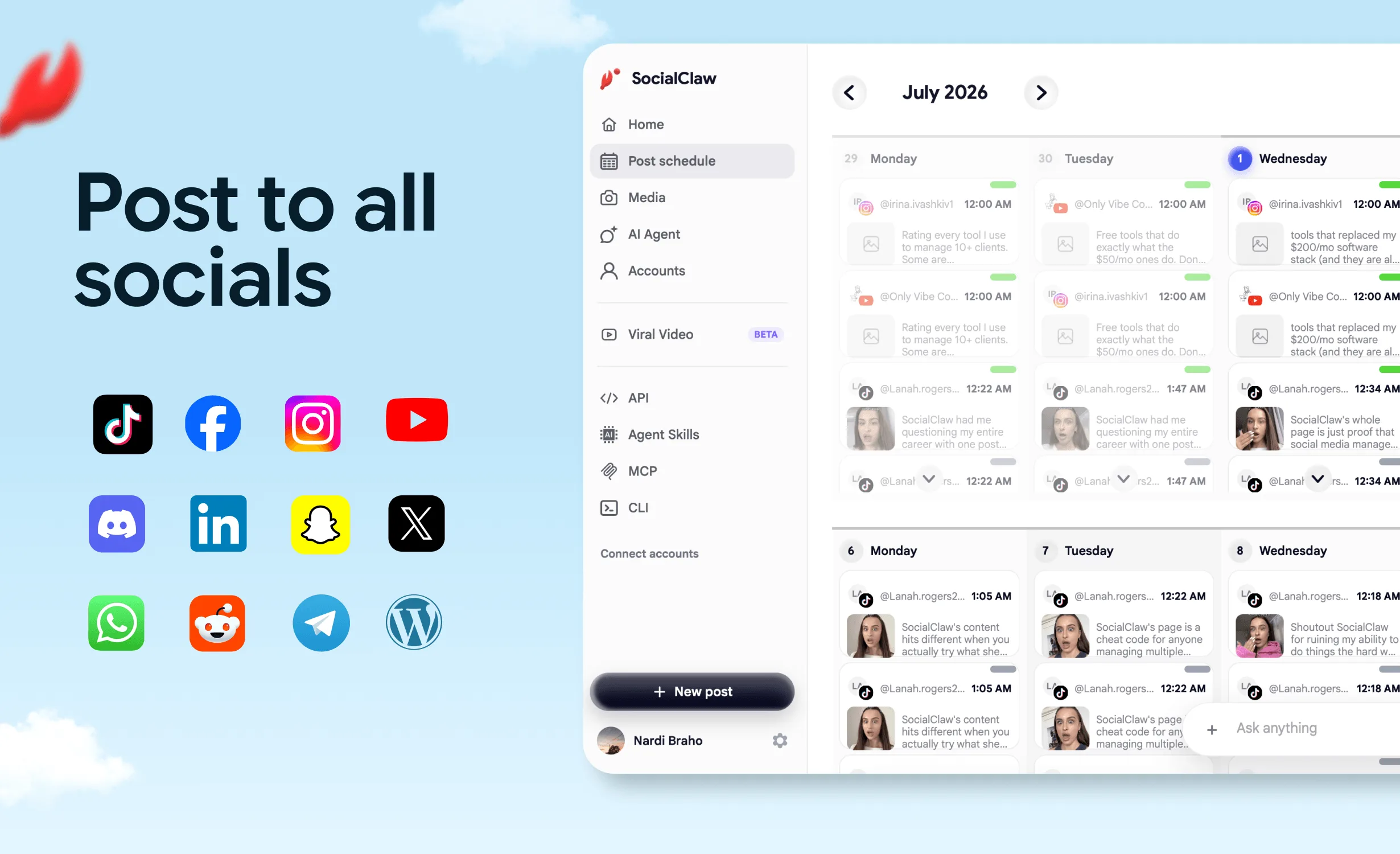
Overall Rating: 9.4 / 10
SocialClaw is the strongest Postiz alternative for any team whose publishing workflow is driven by code, APIs, or AI agents rather than a human clicking through a UI. It is built from the ground up as a social publishing control plane — a backend that your agents, CLIs, and SaaS products can operate against without a human in the loop.
What makes SocialClaw different
The core model is deliberate and opinionated:
- One hosted workspace acts as the system of record for all connected social accounts
- Google sign-in to the dashboard; workspace API key for all automated execution
- Media upload once, reuse everywhere — SocialClaw hosts your media and returns stable public URLs that every supported platform can fetch
- Validate before apply — provider-aware rules checked before any post goes out, catching bad schedules before they hit production
- Full inspection after execution — runs, posts, attempts, analytics, usage, jobs, and health are all queryable by run ID or post ID
- 13 social platforms — X, Facebook Pages, Instagram Business, Instagram (standalone professional), LinkedIn profile, LinkedIn page, Pinterest, TikTok, Discord, Telegram, YouTube, Reddit, WordPress
This is not a minor product distinction. It is a fundamentally different product shape from a visual scheduler.
Why SocialClaw wins for AI agents specifically
When an AI agent is responsible for publishing, three things go wrong regularly with scheduler-first tools:
Problem 1: Media delivery breaks. The agent generates a post with an image URL that the platform cannot fetch — wrong format, expired CDN link, or size limit violation that only surfaces at publish time.
SocialClaw fix: Hosted media upload with provider-aware format handling. The agent uploads once via socialclaw assets upload, SocialClaw returns a stable publicUrl, and that URL works reliably for every supported platform.
Problem 2: Invalid schedules ship. The agent constructs a schedule that violates a provider rule — wrong aspect ratio, missing required field, unsupported media format — and the error only surfaces when the post fails at the platform level.
SocialClaw fix: The validate step runs provider-specific rules before apply. The agent can catch and correct bad schedules before they touch any live platform.
Problem 3: Execution is invisible. The agent fires off a schedule and has no reliable way to know what happened to each post — delivered, failed, retried, or pending.
SocialClaw fix: Every run, post, and attempt is queryable. The agent calls socialclaw status --run-id <id> and gets a complete per-post delivery report with provider response data.
No other alternative on this list has all three of those properties as first-class product surfaces.
Native AI agent integrations
SocialClaw ships two integration paths for AI agent runtimes:
Claude Code plugin:
npx skills add ndesv21/socialclaw
# Installs the full OpenClaw-compatible skill bundle for Claude Code.
Claude slash command:
socialclaw install --claude
# Installs /socialclaw command into ~/.claude/commands/socialclaw.md.
OpenClaw and ClawHub: The skill bundle in the public repository is OpenClaw-compatible and published to ClawHub for discovery. Any OpenClaw-compatible agent runtime can load the SKILL.md and call either the SocialClaw HTTP API or the socialclaw CLI.
Other runtimes: The repository also includes an OpenAI-compatible agent manifest at skill/agents/openai.yaml. The CLI works for any runtime that can execute shell commands or make HTTP requests.
SocialClaw pricing
7-day free trial included. Then four plans:
| Plan | Social Accounts | Posts / Month | Monthly Price | Annual Price |
|---|---|---|---|---|
| Starter | 3 | 200 | $15 / mo | $10 / mo |
| Startup | 6 | 400 | $29 / mo | $19 / mo |
| Plus (most popular) | 20 | 1,000 | $67 / mo | $49 / mo |
| Pro | 50 | 2,500 | $99 / mo | $80 / mo |
All plans include CLI & agent skill access, the hosted workspace API, and media storage. Annual billing saves 19–34%.
SocialClaw rating breakdown
| Category | Score | Notes |
|---|---|---|
| AI Agent Compatibility | 10 / 10 | Native Claude Code plugin, OpenClaw skill, workspace API key auth |
| API Surface | 9.5 / 10 | Full HTTP API: accounts, assets, validate, apply, inspect, analytics, health |
| CLI Experience | 9.5 / 10 | npm CLI, JSON output, all major operations covered |
| Platform Coverage | 9 / 10 | 13 platforms with provider-specific capability handling |
| Validate Before Publish | 10 / 10 | Explicit validate endpoint with provider rules before apply |
| Execution Visibility | 10 / 10 | Run, post, attempt, analytics, job, and health inspection |
| Pricing | 8.5 / 10 | Starts at $15/mo, 7-day free trial, annual savings up to 34% |
| Overall | 9.4 / 10 |
Start free — 7-day trial · View pricing · Read the AI agent guide
#2 Buffer — Best for Simple Team Scheduling
Overall Rating: 6.8 / 10
Buffer is one of the oldest and most recognized social media scheduling tools. It is best suited for small teams or individual creators who want a clean visual calendar to plan and publish content across a handful of accounts.
Buffer does offer a public API and a free tier, which makes it accessible for small-scale experiments. However, it is not built around the workspace API key pattern, has no CLI, no AI agent skill, and no validate-before-apply execution model. The API surface is primarily oriented around queue management — it is designed for humans to move content through a publishing queue, not for agents to operate a publishing control plane.
When Buffer makes sense: You have a 1–3 person team publishing manually reviewed content to a handful of accounts. You want a clean UI with a simple queue model and do not need any programmatic execution.
When Buffer falls short: Any workflow where publishing is driven by code. Buffer's API is not designed for the validate-apply-inspect execution pattern.
| Category | Score |
|---|---|
| AI Agent Compatibility | 3 / 10 |
| API Surface | 5.5 / 10 |
| CLI Experience | 1 / 10 |
| Platform Coverage | 6 / 10 |
| Validate Before Publish | 1 / 10 |
| Execution Visibility | 4 / 10 |
| Pricing | 8 / 10 |
| Overall | 6.8 / 10 |
#3 Publer — Best for Agencies
Overall Rating: 6.5 / 10
Publer is a solid mid-tier scheduler with strong multi-workspace management features, making it popular with agencies managing multiple client accounts. It supports a decent range of platforms and has a more flexible publishing model than Buffer.
Like Buffer, Publer does not have a CLI, no AI agent skill definitions, and its API is primarily focused on content management rather than execution-layer automation. It is a good fit for human-operated agency workflows but does not serve the API-first or agent-first buyer.
When Publer makes sense: Your agency manages 10+ client social accounts manually and you want multi-workspace isolation with a visual approval workflow.
When Publer falls short: You need a programmatic publishing backend. Publer's product shape is oriented around human operators, not code.
| Category | Score |
|---|---|
| AI Agent Compatibility | 3 / 10 |
| API Surface | 5 / 10 |
| CLI Experience | 1 / 10 |
| Platform Coverage | 7 / 10 |
| Validate Before Publish | 2 / 10 |
| Execution Visibility | 4 / 10 |
| Pricing | 7.5 / 10 |
| Overall | 6.5 / 10 |
#4 Later — Best for Visual Content Calendars
Overall Rating: 6.2 / 10
Later is highly optimized for Instagram and TikTok visual content planning. Its drag-and-drop media calendar is genuinely excellent for content creators and social media managers who plan visual campaigns.
However, Later is almost entirely UI-first. Its API exists but is not documented for developer or automation workflows in a way that competes with SocialClaw's workspace API model. There is no CLI, no agent skill, and no execution inspection model.
When Later makes sense: Your publishing is driven by a human reviewing a visual calendar, you are Instagram-heavy, and scheduling precision matters less than visual content planning.
When Later falls short: Any programmatic publishing use case. Later is the wrong tool for code-driven workflows.
| Category | Score |
|---|---|
| AI Agent Compatibility | 2 / 10 |
| API Surface | 4.5 / 10 |
| CLI Experience | 1 / 10 |
| Platform Coverage | 6 / 10 |
| Validate Before Publish | 1 / 10 |
| Execution Visibility | 3 / 10 |
| Pricing | 7 / 10 |
| Overall | 6.2 / 10 |
#5 Hootsuite — Best for Enterprise Teams
Overall Rating: 6.0 / 10
Hootsuite is the enterprise social media management standard. It has approval workflows, compliance features, team permissions, and integrations with enterprise tools. For large marketing teams managing dozens of accounts across many stakeholders, Hootsuite's governance layer is genuinely valuable.
For developers and AI agent builders, Hootsuite is expensive and over-built for the wrong problem. Its API is available but expensive to access, and the product is fundamentally oriented around human-operated social management, not programmatic publishing pipelines.
When Hootsuite makes sense: Enterprise marketing teams with compliance requirements, complex approval chains, and budget for premium governance tooling.
When Hootsuite falls short: Lean startups, developer-first teams, AI agent builders. The cost-to-value ratio is poor for programmatic use cases.
| Category | Score |
|---|---|
| AI Agent Compatibility | 2 / 10 |
| API Surface | 5 / 10 |
| CLI Experience | 1 / 10 |
| Platform Coverage | 8 / 10 |
| Validate Before Publish | 3 / 10 |
| Execution Visibility | 5 / 10 |
| Pricing | 4 / 10 |
| Overall | 6.0 / 10 |
Feature Comparison Table: SocialClaw vs Postiz
This table compares SocialClaw and Postiz across the features that matter most to developer and agent-first buyers. All Postiz facts are sourced from official Postiz materials reviewed March 30, 2026.
| Feature | SocialClaw | Postiz |
|---|---|---|
| Product shape | Publishing control plane / execution backend | All-in-one agentic scheduler |
| Hosted workspace | ✅ One managed workspace | ✅ Hosted offering |
| Self-hosted option | ❌ | ✅ Open-source path |
| Dashboard sign-in | ✅ Google OAuth | Not confirmed in approved sources |
| Workspace API key auth | ✅ First-class auth model for all automation | Not confirmed as primary auth model |
| CLI | ✅ Full npm CLI (socialclaw) | ✅ AI Agents CLI |
| HTTP API | ✅ Full workspace API: accounts, assets, validate, apply, inspect, analytics, health | ✅ Public API |
| Validate before apply | ✅ Explicit validate endpoint with provider rules | Not confirmed |
| Draft campaign preview | ✅ campaigns preview command | Not confirmed |
| Run / post / attempt inspection | ✅ Run, post, attempt, analytics, job, health queryable by ID | Not confirmed |
| Media upload and hosted URLs | ✅ Upload once, reuse via stable public URL | Not confirmed |
| AI agent skill bundle | ✅ Claude Code plugin + OpenClaw / ClawHub | ⚠️ AI Agents CLI (automation surface) |
| n8n integration | ❌ | ✅ Custom n8n node |
| Make.com integration | ❌ | ✅ Make.com integration |
| Social accounts per workspace | 3–50 depending on plan | Varies by plan |
| Posts per month | 200–2,500 depending on plan | Varies by plan |
| Free trial | ✅ 7 days | ✅ 7 days |
| Platforms supported | 13 (see platform table below) | Not confirmed in approved sources |
| Starting price | $15 / month | See postiz.com/pricing |
Platform Coverage Table
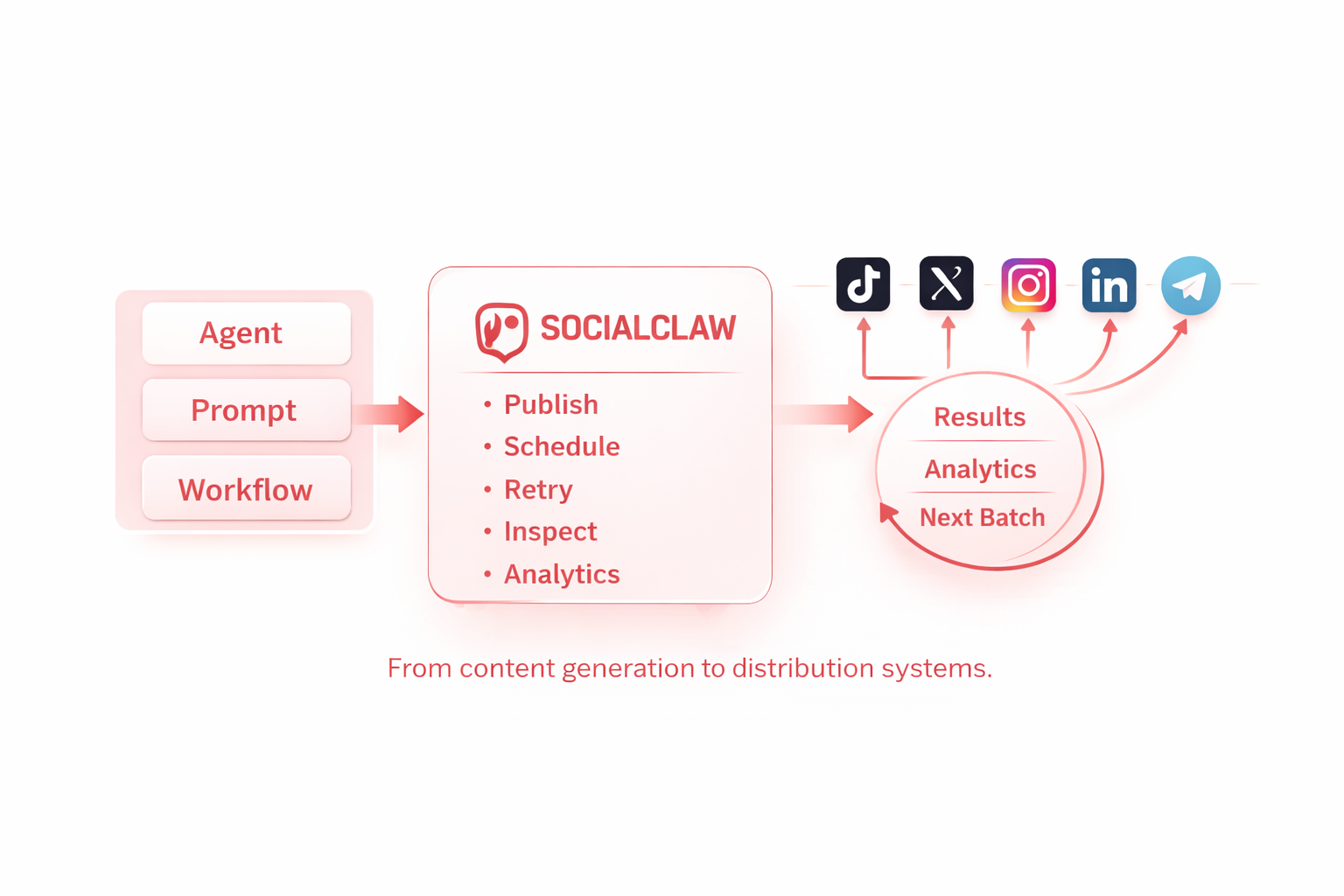
SocialClaw's 13-platform coverage with account types, connect model, and key limitations:
| Platform | Account Type | Connect Model | Media Support | Key Limitation |
|---|---|---|---|---|
| X | X user account | OAuth | Up to 4 images or 1 video | Reply steps are campaign-specific |
| Facebook Pages | Facebook Page | OAuth | 1 image or video | Personal profiles not supported |
| Instagram Business | Page-linked Business account | OAuth via SocialClaw flow | Image or video required | No personal accounts, stories, or carousels |
| Instagram Standalone | Standalone professional account | Instagram Login OAuth | 1 image or 1 reel | Separate from Instagram Business flow |
| LinkedIn Profile | Member profile | OAuth | Text + up to 20 images or 1 video | Non-post interaction steps not implemented |
| LinkedIn Page | Organization page | OAuth | Text + up to 20 images or 1 video | Requires connected member access |
| Board-centric targets | OAuth | Standard, video, and multi-image pins | Product/idea surfaces are capability-gated | |
| TikTok | TikTok account | OAuth | 1 video or 1–35 image gallery | No sound/song selection via Content Posting API |
| Discord | Channel webhook | Manual webhook URL | Text or 1 image/video | No threads, embeds, or polls |
| Telegram | Bot-connected channel | Manual bot token + chat target | Text or 1 image/video | No native threads or analytics |
| YouTube | YouTube channel | OAuth | 1 video per post | No Shorts-specific flows or live streaming |
| User submission target | OAuth | Self posts and link posts | No native image/video/gallery upload | |
| WordPress | WordPress.com or Jetpack | OAuth | Remote media upload and embed | Advanced taxonomy control is thin |
Pricing Comparison Table
| Tool | Free Option | Entry Paid | Mid Tier | Notes |
|---|---|---|---|---|
| SocialClaw | 7-day trial | $15/mo (3 accounts, 200 posts) | $67/mo (20 accounts, 1,000 posts) | All plans include API, CLI, agent skills, media storage |
| Postiz | 7-day trial for $0 | See postiz.com/pricing | — | Open-source self-host option available |
| Buffer | Free tier (3 channels) | ~$6/mo per channel | ~$12/mo per channel | Simple visual scheduler |
| Publer | Free tier | ~$12/mo | ~$40/mo | Agency multi-workspace focus |
| Later | Free tier | ~$18/mo | ~$40/mo | Visual media calendar |
| Hootsuite | 30-day trial | ~$99/mo | ~$249/mo | Enterprise pricing |
SocialClaw annual billing (save 19–34%):
| Plan | Monthly | Annual (per month) | Savings |
|---|---|---|---|
| Starter | $15 | $10 | 33% |
| Startup | $29 | $19 | 34% |
| Plus | $67 | $49 | 27% |
| Pro | $99 | $80 | 19% |
Ratings Summary
| Tool | AI Agent | API | CLI | Platforms | Validate | Inspect | Price | Overall |
|---|---|---|---|---|---|---|---|---|
| SocialClaw | 10 | 9.5 | 9.5 | 9 | 10 | 10 | 8.5 | 9.4 |
| Postiz | 6 | 7 | 6 | 7 | 4 | 5 | 8 | 6.7 |
| Buffer | 3 | 5.5 | 1 | 6 | 1 | 4 | 8 | 6.8 |
| Publer | 3 | 5 | 1 | 7 | 2 | 4 | 7.5 | 6.5 |
| Later | 2 | 4.5 | 1 | 6 | 1 | 3 | 7 | 6.2 |
| Hootsuite | 2 | 5 | 1 | 8 | 3 | 5 | 4 | 6.0 |
Scores are 1–10 per category. Overall is a weighted average emphasizing API surface, agent compatibility, and execution visibility — the criteria that matter most for developer-led workflows.
Watch SocialClaw in Action
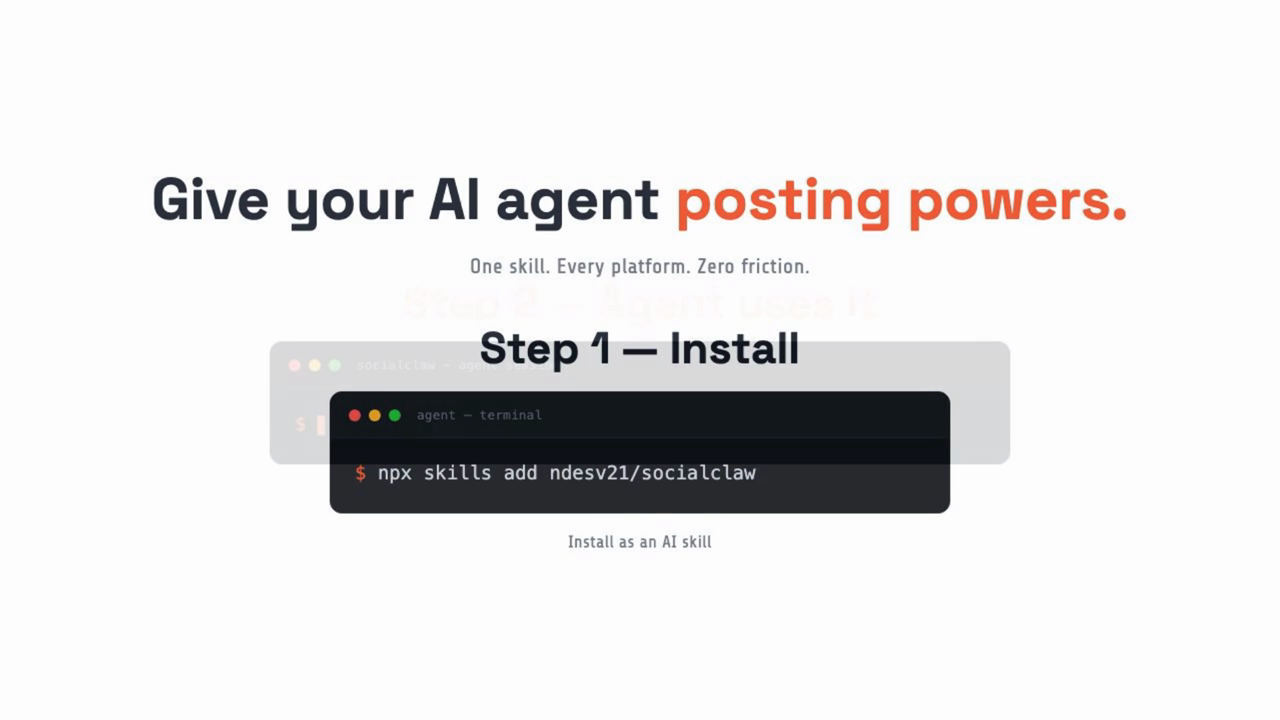
Click to watch the SocialClaw demo on YouTube — see account connect, media upload, validate, apply, and post inspection in a single end-to-end agent workflow.

SocialClaw Workflow Walkthrough
Here is what a complete SocialClaw publishing workflow looks like, from CLI setup through delivery inspection.
Step 1 — Login and workspace setup
# Open the dashboard to sign in with Google, connect accounts,
# and create your workspace API key.
socialclaw login

# Authenticate the CLI with your workspace API key.
socialclaw login --api-key <workspace-key> --base-url https://getsocialclaw.com
Step 2 — Connect social accounts
# List all accounts already connected in your workspace.
socialclaw accounts list --json

# OAuth browser flows for most providers.
socialclaw accounts connect --provider linkedin --open
socialclaw accounts connect --provider x --open
socialclaw accounts connect --provider tiktok --open

# Webhook-based providers (no OAuth).
socialclaw accounts connect --provider discord --webhook-url <webhook-url> --json
socialclaw accounts connect --provider telegram --bot-token <token> --chat-id @yourchannel --json

# Inspect capabilities for a connected account.
socialclaw accounts capabilities --account-id <account-id> --json
Step 3 — Upload media once
# Upload an image. SocialClaw returns a stable hosted public URL.
socialclaw assets upload --file ./launch-image.png --json
# Response: { "publicUrl": "https://cdn.getsocialclaw.com/...", "assetId": "..." }

# That publicUrl is reusable across any number of posts and runs.
Step 4 — Build and validate the schedule
Create a schedule.json:
{
  "steps": [
    {
      "accountId": "<linkedin-account-id>",
      "provider": "linkedin",
      "text": "Launching our new product — available now at getsocialclaw.com.",
      "mediaUrls": ["https://cdn.getsocialclaw.com/assets/launch-image.png"],
      "scheduledAt": "2026-06-01T09:00:00Z"
    },
    {
      "accountId": "<x-account-id>",
      "provider": "x",
      "text": "New product drop. Thread below.",
      "mediaUrls": ["https://cdn.getsocialclaw.com/assets/launch-image.png"],
      "scheduledAt": "2026-06-01T09:05:00Z"
    }
  ]
}
Then validate before touching any live platform:
socialclaw validate -f schedule.json --json
# Returns field-level errors, provider rule violations, and warnings.
# Fix any issues before proceeding to apply.

socialclaw campaigns preview -f schedule.json --json
# Preview the full campaign before committing to apply.
Step 5 — Apply the schedule
socialclaw apply -f schedule.json --json
# Executes the validated schedule. Returns a run ID.
# { "runId": "run_abc123", "status": "queued" }
Step 6 — Inspect execution state
# Check per-post delivery state for a run.
socialclaw status --run-id run_abc123 --json

# Inspect a specific post's delivery outcome and provider response.
socialclaw posts get --post-id <post-id> --json

# Pull engagement analytics for a completed run.
socialclaw analytics run --run-id run_abc123 --json

# Check workspace health, account connection state, and quota.
socialclaw workspace health --json
This validate → apply → inspect pattern is the fundamental execution loop that makes SocialClaw reliable for agent-driven workflows. No other alternative in this list exposes all three steps as queryable product surfaces.
HTTP API equivalent
Every CLI command has an HTTP API equivalent for any language or runtime:
# Upload media
curl -sS \
  -X POST \
  -H "Authorization: Bearer $SC_API_KEY" \
  -F "file=@./launch-image.png" \
  "https://getsocialclaw.com/v1/assets/upload"

# Validate
curl -sS \
  -X POST \
  -H "Authorization: Bearer $SC_API_KEY" \
  -H "Content-Type: application/json" \
  -d @schedule.json \
  "https://getsocialclaw.com/v1/posts/validate"

# Apply
curl -sS \
  -X POST \
  -H "Authorization: Bearer $SC_API_KEY" \
  -H "Content-Type: application/json" \
  -d @schedule.json \
  "https://getsocialclaw.com/v1/posts/apply"

# Inspect
curl -sS \
  -H "Authorization: Bearer $SC_API_KEY" \
  "https://getsocialclaw.com/v1/runs/<run-id>/status"
Migrating from Postiz to SocialClaw
If you are moving an existing Postiz-based workflow to SocialClaw, here is what changes and what stays the same.
What changes: account reconnection
You will need to reconnect your social accounts inside the SocialClaw workspace. This is an OAuth browser flow for most providers and a manual token/webhook flow for Discord and Telegram.
socialclaw accounts connect --provider x --open
socialclaw accounts connect --provider linkedin --open
socialclaw accounts connect --provider instagram --open
socialclaw accounts connect --provider tiktok --open
# Repeat for each provider you need.
What changes: schedule format
SocialClaw uses JSON or YAML schedule files for validate and apply. Your Postiz schedules will need to be translated to this format. The key fields per step are accountId, provider, text, mediaUrls, and scheduledAt.
What changes: automation credentials
Replace any Postiz API tokens in your automation environment with a SocialClaw workspace API key. The workspace API key is the single auth boundary for all CLI, HTTP API, and agent operations.
export SC_API_KEY="your-workspace-api-key"
socialclaw accounts list --json   # verify workspace connectivity
socialclaw workspace health --json  # confirm all accounts are healthy
What stays the same: the publishing goal
You are still connecting accounts, uploading media, scheduling posts, and checking delivery. The mental model around the work does not change. What changes is the execution layer:
| Postiz workflow | SocialClaw equivalent |
|---|---|
| Create post in scheduler UI | Build a schedule.json or schedule.yaml |
| Publish (manual or automated) | socialclaw validate then socialclaw apply |
| Check post status in UI | socialclaw status --run-id <id> |
| View analytics in dashboard | socialclaw analytics run --run-id <id> |
| Use n8n or Make automation | Call the SocialClaw HTTP API from your workflow |
That shift typically takes one day for most teams and immediately improves execution reliability for agentic workflows.
FAQs
What is the best Postiz alternative for AI agents?
SocialClaw is the strongest Postiz alternative for AI agent workflows. It provides a workspace API key auth model, a hosted publishing layer, validate-before-apply execution, run/post inspection, and native skill integrations for Claude Code and OpenClaw-compatible runtimes. No other tool in this comparison has all of those properties as first-class product surfaces.
Is there a Postiz alternative with a full public API?
Yes. SocialClaw provides a complete hosted HTTP API accessible with a workspace API key. The API covers account management, media upload, schedule validation, apply, status inspection, analytics, and health checks — the full publishing lifecycle, not just queue management.
Does SocialClaw have a free trial?
Yes. SocialClaw offers a 7-day free trial with full access to the hosted workspace, CLI, API, and agent skill workflows. No credit card is required to start.
How many social platforms does SocialClaw support?
SocialClaw supports 13 social platforms: X, Facebook Pages, Instagram Business, Instagram standalone professional accounts, LinkedIn profiles, LinkedIn pages, Pinterest, TikTok, Discord, Telegram, YouTube, Reddit, and WordPress.
Can I use SocialClaw with Claude Code?
Yes. SocialClaw ships a native Claude Code skill and plugin. Install with npx skills add ndesv21/socialclaw for the full OpenClaw-compatible skill bundle, or socialclaw install --claude for the /socialclaw slash command in Claude Code. Claude can then connect accounts, schedule posts, upload media, and inspect delivery directly within any agent conversation.
Does SocialClaw replace Postiz completely?
SocialClaw replaces Postiz for teams that need a hosted API execution layer for agent-driven or programmatic publishing. If you primarily want an all-in-one visual scheduler with an open-source self-hosted deployment option and built-in n8n or Make integrations, Postiz may still suit your workflow. The choice depends on whether your publishing is human-operated or code-operated.
What is the difference between Postiz and SocialClaw?
Postiz is an all-in-one agentic scheduler with hosted and self-hosted deployment options, targeting creators, businesses, and agencies. SocialClaw is a narrower, infrastructure-first social publishing backend with a workspace API key model, validate-before-apply execution, media hosting, and native AI agent skill integrations. SocialClaw is the better choice when you need a reliable publishing control plane for agent workflows or embedded SaaS products.
Can I embed SocialClaw into my own SaaS product?
Yes. SocialClaw is designed for this use case. Connect customer-owned accounts inside a SocialClaw workspace, issue a workspace API key, and use the HTTP API to drive publishing, validation, and inspection from your own product surface. Your end users never need to interact with the SocialClaw dashboard directly.
Does SocialClaw work with OpenClaw?
Yes. The SocialClaw skill bundle in the public repository is OpenClaw-compatible and published to ClawHub for discovery. Any OpenClaw-compatible agent runtime that can load a SKILL.md and call either the SocialClaw HTTP API or the socialclaw CLI can use the skill directly.
Final Verdict

The best Postiz alternative depends entirely on your job to be done:
- You want a visual scheduler for a human team → Buffer or Publer are simpler, cheaper Postiz alternatives with cleaner UIs for that purpose
- You want visual Instagram and TikTok content calendars → Later has the best visual planning surface for that workflow
- You want enterprise governance and compliance features → Hootsuite is the standard-bearer for that requirement
- You want the Postiz product shape with self-hosted flexibility → Postiz itself remains worth evaluating if open-source deployment is your primary constraint
But if your publishing is driven by code — an AI agent, a CLI automation, an embedded SaaS product, or any agentic workflow that needs reliable, inspectable execution state — SocialClaw is the clear winner and the only tool in this comparison built for that job from the start.
The validate → apply → inspect execution model, workspace API key auth, hosted media delivery, and native Claude Code and OpenClaw skill support are not features bolted onto a scheduler. They are the product. That is why SocialClaw leads this ranking by a significant margin for developer and agent-first buyers.
Try SocialClaw free for 7 days — no credit card required.
Start free → · View pricing · Read the AI agent guide · Compare SocialClaw vs Postiz
Postiz facts in this article are sourced from official Postiz materials reviewed March 30, 2026. SocialClaw facts are sourced from first-party product documentation. Last updated: May 27, 2026.