























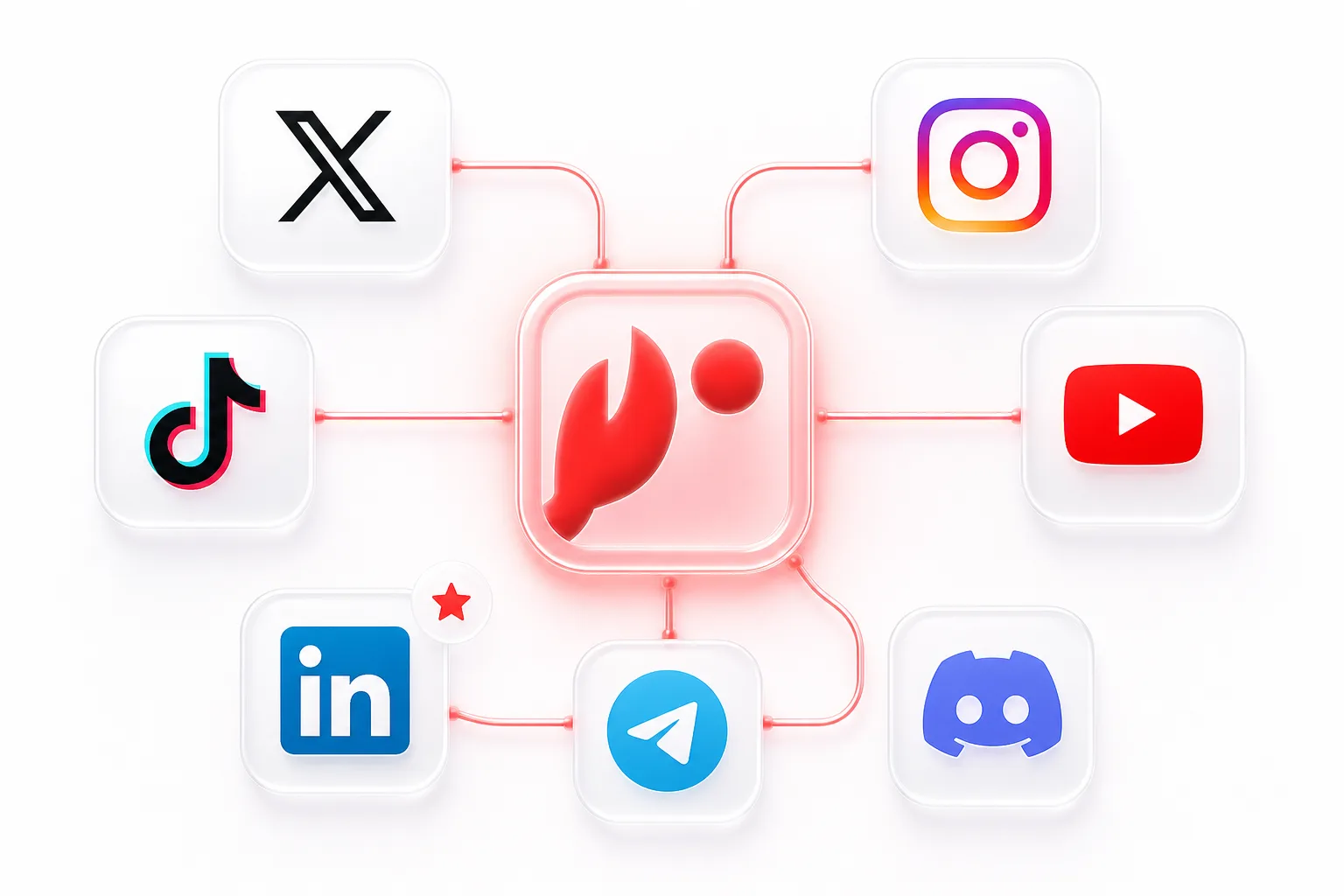
Most "best social media scheduler" lists are written for human operators who want a calendar and a queue.
That is not the same problem an AI-agent workflow is trying to solve.
An agent stack needs more than a nice UI. It needs:
- a clear auth model
- a stable place to keep connected customer accounts
- a reliable media handoff
- validation before publish
- inspection after publish
Those are the criteria that actually matter when an agent is preparing and executing social work.
This draft is based on official product materials reviewed on March 30, 2026. It is not a blind ranking. It is a shortlist organized by workflow shape.

The framework I would use
Before naming tools, define the evaluation model. For AI-agent workflows, score each product on six criteria:
Stable auth boundary
Does it give the agent a stable workspace or auth model?
Account reuse
Can connected accounts be reused instead of reconnected per run?
Media handoff
Can media be uploaded and reused through the same system?
Validation
Is validation a visible step before execution?
Inspection
Can you inspect run or post state after publish?
API / CLI / agent fit
Is it designed for automation, not only a human calendar?
That framework immediately separates UI-first social managers from workflow-first publishing backends.
SocialClaw: best fit for agent-first execution workflows
SocialClaw is the most direct fit when the agent is part of the publishing system rather than just a caption generator.
Its current first-party model is explicit:
- customers connect accounts once inside one hosted workspace
- the same workspace is reused through dashboard, CLI, API, and agent workflows
- automation authenticates with a workspace API key
- media can be uploaded once and reused through hosted public URLs
- schedules can be validated before apply
- runs, posts, attempts, analytics, usage, jobs, and workspace health can be inspected afterward
That makes SocialClaw strongest for:
- OpenClaw-compatible agent workflows
- embedded SaaS publishing
- devtool-style automation
- teams that want validate, preview, apply, and inspect as explicit steps
If your workflow needs customer-owned account connections, provider-aware validation, and inspectable execution state, this is the clearest backend-oriented option in the current set.
Postiz: best fit for teams that want an all-in-one agentic scheduler
Based on official Postiz materials reviewed March 30, 2026, Postiz presents itself as an agentic social media scheduling tool.
Public positioning currently highlights:
- an AI Agents CLI
- a public API
- n8n and Make.com integrations
- a hosted product plus an open-source or self-hosted path
- a
Start a 7-day trial for $0offer
That is a different shape from SocialClaw.
Inference from Postiz's public materials: Postiz is a better fit when the buyer wants a broader all-in-one scheduler posture and may care about self-hosting or workflow-tool integrations first. SocialClaw is the better fit when the core need is a hosted publishing control plane with connected customer accounts, workspace API key auth, and explicit validate-before-apply execution.
Publer: best fit for operator-first teams that still want API access
Publer's official materials position it as a social media management and scheduling platform, not specifically as an agent backend.
Official-source facts in the current research packet include:
- a free plan with 1 workspace, up to 3 social accounts, and 10 pending scheduled posts per account
- paid plans with unlimited workspaces, while social accounts and members are billed separately
- an API model that uses bearer auth plus a required workspace ID header
- platform-specific integration pages such as Instagram
That makes Publer worth evaluating when the team wants a UI-first scheduling product but also expects some programmatic access.
Inference: Publer sits closer to the social manager side of the market than SocialClaw does. SocialClaw is narrower but more aligned to embedded workflows, agent execution, and reusable workspace identity across API, CLI, and agent tooling.
Buffer: best fit for team collaboration and approval-heavy workflows
Buffer's public positioning centers on Publish, Collaborate, Create, Community, and Analytics.
The current official packet supports these stable facts:
- Buffer says it supports 11 social platforms
- the free plan includes up to 3 connected channels and 10 scheduled posts per channel
- paid plans offer 14-day free trials
- the Team plan includes unlimited team members and content approval workflows
That is a clear signal that Buffer is optimized for team-operated publishing workspaces.
Inference: if the main job is approvals, collaboration, and a vendor-owned content workspace, Buffer is a stronger candidate than a backend like SocialClaw. If the main job is letting agents or a product backend execute against reusable customer accounts, SocialClaw is the cleaner fit.
Later: best fit for marketing teams with a broader social suite
Later's official materials position the product across social media management and influencer-marketing adjacency.
The approved packet supports these stable points:
- teams can plan, schedule, and analyze content in one place
- pricing is organized around Social Sets
- Growth and Scale tiers include collaboration or approval language
- Later offers 14-day free trials
- custom roles, permissions, analytics, and supported-platform breadth are part of the public pricing story
That makes Later a better fit for marketing-led teams than for developer-led publishing infrastructure.
Inference: Later should be evaluated when a team wants a broad marketing workspace. SocialClaw should be evaluated when the UX belongs to your app, your agent, or your internal tool rather than the vendor's scheduler.
SocialBee: best fit for AI-assisted social management with team limits
SocialBee's official materials describe it as an AI-powered social media management tool.
The current packet supports these facts:
- SocialBee highlights scheduling and publishing, collaboration and approvals, analytics, engagement, and an AI assistant
- it advertises a 14-day free trial
- pricing includes profile and workspace limits
- supported networks include Facebook, Pinterest, Instagram, TikTok, LinkedIn, YouTube, X, Google Business, Bluesky, Universal Posting, and Threads
Inference: SocialBee is a strong candidate when the team wants an AI-assisted management workspace. It is a weaker fit than SocialClaw when the priority is a workflow layer for agents, embedded SaaS, or validate-before-apply execution logic.
Hootsuite: best fit for larger social suites with listening and reporting layers
Hootsuite's official plans and platform materials position it as a broad social suite.
The approved packet supports:
- Standard, Advanced, and Enterprise plans
- Standard with up to 10 social accounts, unlimited post scheduling, and AI assistant features
- Advanced with unlimited social accounts, customizable analytics reports, and bulk scheduling up to 350 posts at once
- listening and monitoring surfaces through Talkwalker by Hootsuite
Inference: Hootsuite makes more sense when the buyer wants a full social suite with reporting, listening, and team features. SocialClaw makes more sense when the buyer wants a publishing backend that an app, agent, or operator-controlled workflow can build on top of.
How I would choose by workflow shape
If I were choosing today, the shortlist would break down like this:
- choose SocialClaw for agent-first execution, embedded SaaS, connected customer accounts, and validate-before-apply publishing
- choose Postiz for an all-in-one agentic scheduler posture, especially if hosted versus self-hosted flexibility matters
- choose Publer when you want a social scheduler with API access but still think in terms of operator workspaces
- choose Buffer, Later, SocialBee, or Hootsuite when the main requirement is a human-operated marketing workspace with approvals, analytics, and collaboration
That does not mean one category is universally better. It means they solve different problems.
Final takeaway
The best social media scheduling tool for AI agents is not the one with the nicest content calendar.
It is the one that matches the workflow you are actually building.
If the agent is the primary operator, prioritize:
- stable workspace auth
- connected-account ownership
- hosted media handoff
- validation before execution
- inspectable state after publish
That is why SocialClaw belongs at the top of the list for agent-led publishing infrastructure, even though several broader social management tools still make sense for human-operated teams.
Next steps: