























Media handoff is one of the most fragile parts of social automation.
Teams often build the rest of the workflow first, then realize the publish step still depends on a file living somewhere temporary, inaccessible, or inconsistent between runs.
That is why "upload once and reuse" is not just a storage convenience. It is part of the publishing architecture.
SocialClaw treats media that way. The workflow can upload an asset into the workspace, receive a hosted publicUrl, and reuse that media handoff across validation, draft review, scheduled publishing, and later inspection.
Why media handoff breaks so many workflows
The common failure modes are easy to recognize:
- the file URL expires before the publish worker reaches it
- the agent and the publishing system are looking at different storage locations
- the asset has to be reuploaded for every small revision
- retries become harder because the original media handoff is no longer stable
That is exactly why media should live close to the publish system rather than floating around as an unrelated external dependency.
The better model: upload once, reuse the hosted URL
SocialClaw supports a cleaner pattern:
- upload the asset into the workspace
- receive a hosted
publicUrl - reuse that URL in schedule payloads
- validate before apply
- inspect the run after publish
A simple CLI upload looks like this:
socialclaw assets upload --file ./creative/release-video.mp4 --jsonThere is also an HTTP version for backend workflows:
curl -sS \
  -X POST \
  -H "Authorization: Bearer $SC_API_KEY" \
  -F "file=@./creative/release-video.mp4" \
  "https://getsocialclaw.com/v1/assets/upload"
That model is easier to reason about because the workflow is no longer depending on ad hoc file hosting outside the same system that validates and applies the schedule.
What the upload flow gives you
The hosted upload flow is useful for several reasons:
- the upload response includes a reusable
publicUrl - the workspace controls the media handoff point used in later schedules
- the workflow can keep storage credentials on the SocialClaw side instead of inside the agent
- retention and cleanup stay close to the same system that owns the publish workflow
That last point matters more than it first appears. If the publish system owns both the media handoff and the schedule execution, debugging gets much simpler when something fails.
Reuse matters across drafts, retries, and multi-channel runs
The most obvious use case is one asset across multiple channels.
For example, one launch image or one short product video may be reused in:
- an X post
- a LinkedIn update
- a Discord announcement
- a later rerun of the same campaign
The same hosted URL can also survive long enough to support:
- a draft campaign preview
- a validation pass
- a later apply
- inspection after publish
That is much better than building a workflow where each stage has to rediscover or recreate the asset.
Provider rules still matter after upload
Uploading once does not flatten provider differences.
The asset still has to fit the connected target.
Current first-party SocialClaw truth keeps those boundaries clear:
- TikTok requires a public video URL, including a SocialClaw-hosted video URL
- YouTube publishes one video per post
- Instagram publishing requires media
- X supports up to four images or one video
- LinkedIn member profiles and LinkedIn pages support text plus one video or up to twenty images
- Discord and Telegram currently support text-only or one image or one video
That is why hosted media handoff and validation belong together. Uploading the asset solves the delivery problem. Validation still solves the route-fit problem.
A practical upload-once workflow
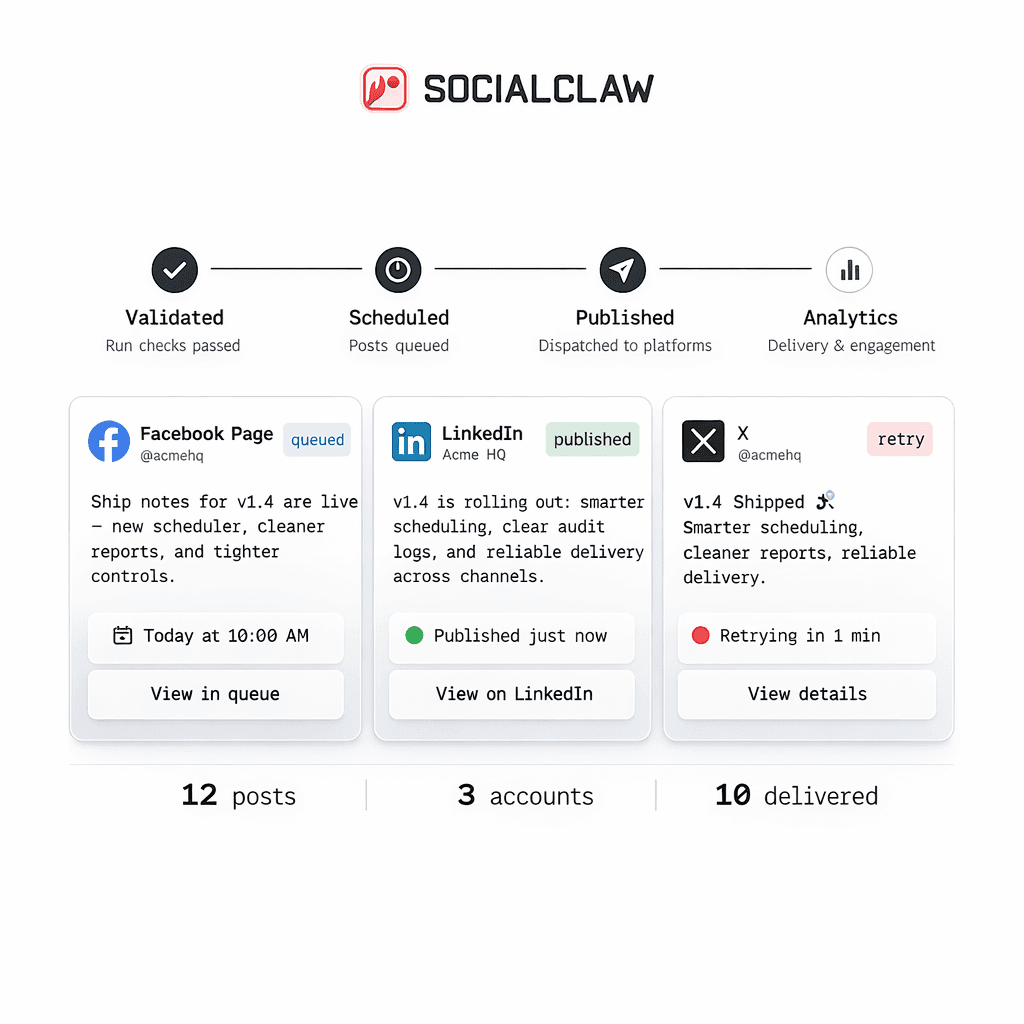
The end-to-end workflow is straightforward:
- upload the file into the workspace
- use the returned
publicUrlin the schedule payload - validate the schedule
- preview the campaign if review is needed
- apply the run
- inspect the result
A simple CLI sequence looks like this:
socialclaw assets upload --file ./creative/launch.png --json
socialclaw validate -f schedule.json --json
socialclaw campaigns preview -f schedule.json --json
socialclaw apply -f schedule.json --json
socialclaw status --run-id <run-id> --json
That gives the workflow one consistent media handoff instead of a separate storage problem at every stage.
Why this is better than ad hoc file hosting
The advantage is not just convenience.
This pattern gives you:
- a more stable media delivery point
- fewer secrets inside agent workflows
- easier reuse across runs
- simpler debugging when a publish fails
It also keeps media close to the same workspace that already owns connected accounts, validation, and run inspection.
What this does not mean
It is important to keep the claim precise.
Uploading once does not mean:
- every provider accepts the same asset shape
- every route supports the same number of images or videos
- validation is no longer necessary
- SocialClaw is pretending to be a universal CDN product
The point is narrower and more practical: hosted media handoff makes social publishing workflows more predictable.
Where this pattern fits best
This is especially useful when you are running:
- agent-driven campaign workflows
- embedded SaaS publishing
- multi-channel schedules
- drafts that may be reviewed before final apply
Those are the environments where a stable hosted media handoff pays off quickly.
Final takeaway
Media reuse is part of publishing infrastructure, not a side feature.
If the workflow has to upload, validate, preview, publish, and inspect, it is much stronger when the asset lives inside the same system that handles the rest of the publish path.
That is what makes "upload once, reuse many times" a real workflow improvement instead of a storage slogan.
Next steps: