























If you are adding social publishing to a product or an agent in 2026, the first architectural decision is not which library to use. It is whether to integrate each platform's API directly or go through a unified social media API.
Direct integration means seven or more separate OAuth implementations, seven token refresh schedules, seven media upload pipelines, and seven sets of rate limits that change without warning. A unified API means one auth model and one payload shape, at the cost of a dependency and a subscription.
This roundup covers both routes honestly: the unified APIs worth using (SocialClaw, Ayrshare, Blotato), when going direct is actually the right call, and the questions that separate a demo-quality integration from one that survives production.
Nardi Braho - July 4, 2026
TL;DR — which to pick
- SocialClaw — agent and product workflows that need validate-before-apply, hosted media, and MCP/CLI/API from one workspace key.
- Ayrshare — agencies and SaaS with many client profiles; official SDKs in Node.js, Python, PHP, Go, Java, C#, and Ruby; broadest network list.
- Blotato — creator workflows where AI content generation and posting live in one credit-based product.
- Direct platform APIs — one or two platforms, deep platform-specific features, and a team willing to own OAuth and API churn.
How do the main options compare?
| Option | Auth model | Platforms | Media handling | Agent surface | Best for |
|---|---|---|---|---|---|
| SocialClaw | One workspace API key (sc_live_...) | 11: X, LinkedIn, Instagram, Facebook Pages, TikTok, Discord, Telegram, YouTube, Reddit, WordPress, Pinterest | Hosted media: upload once, reuse across posts | HTTP API, CLI, hosted + stdio MCP server | Products and AI agents that need validated, inspectable publishing |
| Ayrshare | API key, per-profile user model | 13+ networks incl. Bluesky, Threads, Google Business Profile | Media upload endpoints | Unified API, SDKs in 7 languages, MCP server | Agencies and SaaS managing many client profiles |
| Blotato | API key on paid plans, credit-metered AI | 9+ platforms incl. Threads and Bluesky | Media handled inside the content suite | API, hosted MCP at mcp.blotato.com/mcp, n8n/Make nodes | Creators who want AI content generation bundled with posting |
| Direct platform APIs | Separate OAuth app per platform | Whatever you build | You build upload, transcode, and retry per platform | Whatever you build | Single-platform depth, full control, no middleman |
Competitor rows above come from each vendor's public pages as documented in SocialClaw's comparison research; verify plan-specific details against official docs before committing.
What should developers look for in a social media API?
Four things break social integrations in production, and they are rarely in the demo.
Authentication and token lifecycles
Every platform OAuth flow has its own scopes, expiry rules, and re-consent quirks. Direct integrations mean you own token refresh for each. A unified API absorbs this: with SocialClaw, accounts are connected once as connected customer accounts inside a hosted workspace, and every surface — dashboard, API, CLI, agent — reuses them with one workspace API key.
Rate limits and pricing shocks
Platform API economics change fast. As of 2026, X's API defaults to pay-per-use pricing for new developers (announced on the X developer forums, with per-request pricing in the official docs); the legacy Basic and Pro tiers are closed to new signups. If your product's unit economics depend on a platform's API pricing, a unified layer at least gives you one predictable bill.
Media handling
Uploading a video to seven platforms means seven different size limits, container formats, and chunked-upload protocols. Look for hosted media: SocialClaw lets you upload an asset once and reference the hosted URL across every post. It also absorbs platform quirks — TikTok photo posts reject PNG (file_format_check_failed; JPEG/WebP only), and SocialClaw auto-converts via a ?format=jpeg parameter instead of failing the post.
Delivery verification
The most dangerous API response in this category is 202 Accepted. Platform "accepted" is not the same as published — posts can die in the platform's processing queue after your API call succeeds. A production-grade API exposes post state after publish. SocialClaw's run_status and post_attempts exist specifically so you can inspect run and post state after publish instead of assuming success.
Which unified social media APIs are best in 2026?
SocialClaw — validation-first publishing for products and agents
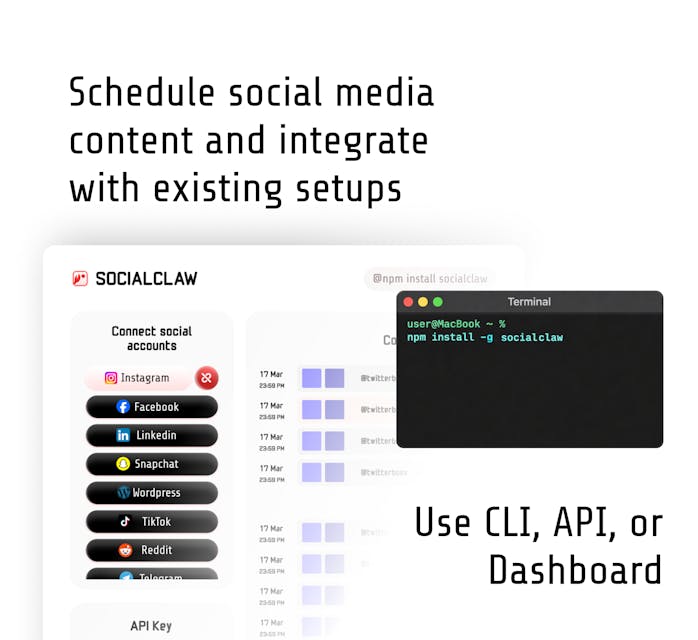
SocialClaw is a hosted publishing layer: connected customer accounts live in one workspace, and the HTTP API, CLI (npm install -g socialclaw), and MCP server all authenticate with the same workspace API key. The pipeline is explicit — validate before apply, then inspect:
# Upload media once, get a hosted asset
curl -sS -X POST \
  -H "Authorization: Bearer $SC_API_KEY" \
  -F "file=@./launch-image.png" \
  "https://getsocialclaw.com/v1/assets/upload"

# Validate the schedule before anything publishes
curl -sS -X POST \
  -H "Authorization: Bearer $SC_API_KEY" \
  -H "Content-Type: application/json" \
  -d @schedule.json \
  "https://getsocialclaw.com/v1/posts/validate"

# Apply, then inspect the run
curl -sS -X POST \
  -H "Authorization: Bearer $SC_API_KEY" \
  -H "Content-Type: application/json" \
  -d @schedule.json \
  "https://getsocialclaw.com/v1/posts/apply"

curl -sS -H "Authorization: Bearer $SC_API_KEY" \
  "https://getsocialclaw.com/v1/runs/<run-id>/status"
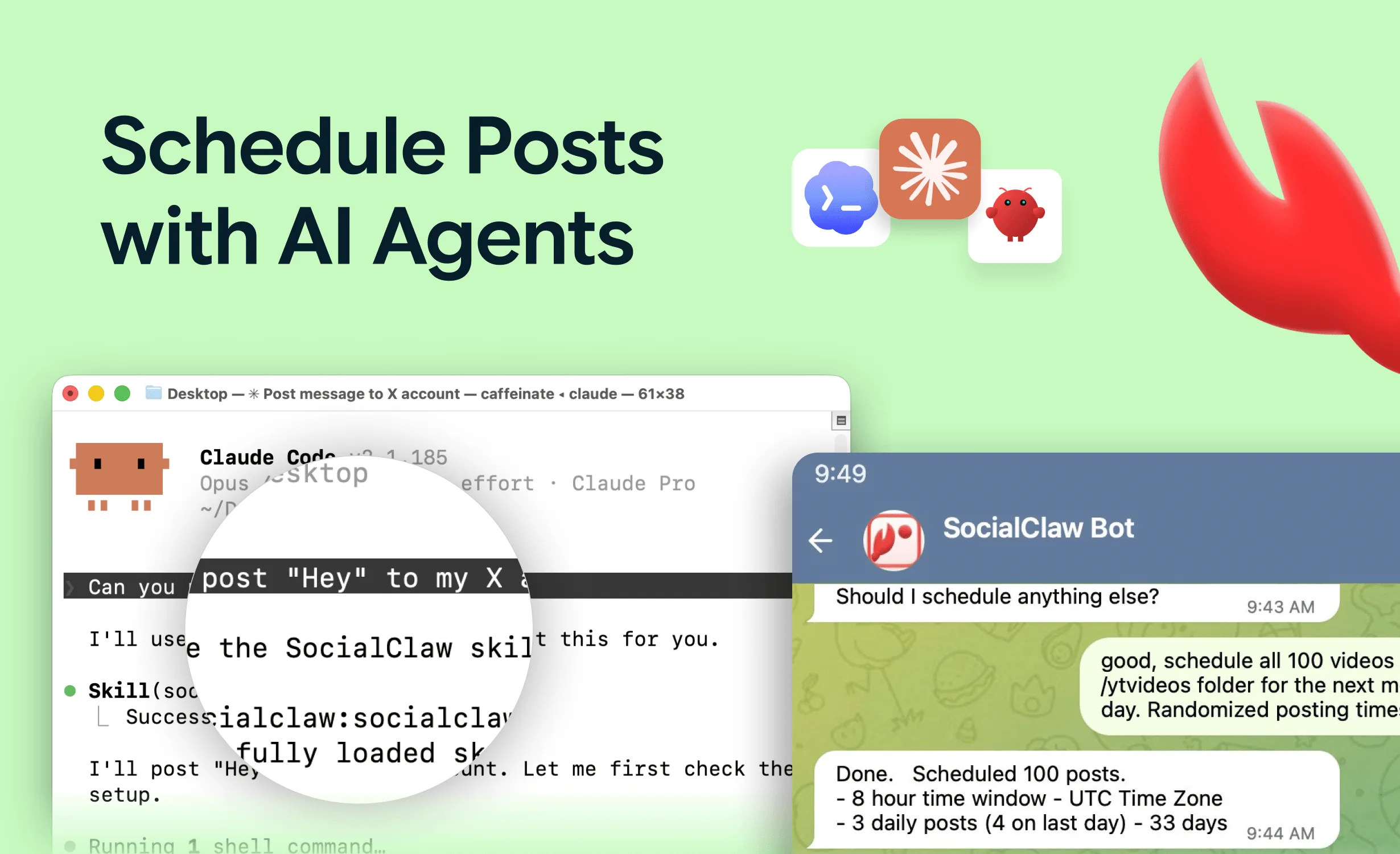
For AI agents, the same workspace is exposed as an MCP server with 17 tools (validate_schedule, apply_schedule, run_status, get_analytics, and more), hosted at https://getsocialclaw.com/mcp. That matters if your roadmap includes agent-driven publishing — you get the API and the agent surface from one integration. Non-developer teammates are covered too: a native agent inside the SocialClaw dashboard drafts, schedules, and publishes from chat (no MCP client needed), and an AI viral video generator turns app screenshots or a screen recording into UGC-style videos. See the MCP server roundup and the Claude Agent SDK build guide for the agent side of the story. Free tier available, flat plans $15–99/mo — one of the lowest-priced options in this roundup, roughly half the entry price of comparable cloud tiers; docs at getsocialclaw.com/docs/api.
Honest limits: 11 platforms, all via official platform APIs — no Bluesky, Threads, or Google Business Profile today. No official SDK zoo; it is HTTP plus a CLI.
Ayrshare — the established unified API for multi-client SaaS
Ayrshare has been the default unified social media API for years, and its public pages position it for scalable apps and AI agents. It lists 13+ networks — including Bluesky, Threads, and Google Business Profile, which SocialClaw does not currently publish to — ships official SDKs for Node.js, Python, PHP, Go, Java, C#, and Ruby, and offers an MCP server for Claude, Cursor, and other MCP clients. It also covers adjacent surfaces like review management and messaging with auto-responses.
If you are an agency or a SaaS embedding posting for many client profiles, Ayrshare's per-profile user model is built for exactly that. The trade-off versus SocialClaw is the workflow model: SocialClaw's validate/apply/inspect pipeline and single-workspace key are more opinionated about safe agent execution. Full comparison: SocialClaw vs Ayrshare.
Blotato — content generation and posting in one product
Blotato comes at the problem from the content side: AI writing, image generation, and faceless AI video metered by credits, with cross-posting to 9+ platforms (including Threads and Bluesky), full API access on paid plans, official n8n and Make nodes, and a hosted MCP server at mcp.blotato.com/mcp. For solo creators and small teams that want generation and distribution in one subscription, that bundle is genuinely convenient.
For developers, the caveat is that the API is part of a credit-based creator suite rather than a standalone publishing infrastructure product — pricing scales with AI credits, not just API calls.
When should you integrate platform APIs directly?
Going direct is the right call more often than unified-API vendors admit:
- You need one platform, deeply. Building a YouTube analytics product? Use the YouTube Data API directly — a unified posting layer adds nothing.
- You need features unified APIs do not expose. Platform-specific ad APIs, DMs, or listening endpoints usually are not in publishing-focused unified APIs.
- You cannot accept a vendor dependency for compliance or latency reasons.
The costs are real, though: separate OAuth app reviews (Meta and TikTok both gate publishing behind app review/audit processes), per-platform media pipelines, and pricing exposure like X's pay-per-use shift. Most teams that start with two direct integrations and then need a third are exactly who unified APIs exist for. If the deeper question is what a publishing API even is versus a management tool, start with what is a social media publishing API.
How do you choose for an embedded SaaS use case?
If the accounts belong to your customers — you are embedding scheduling inside your own SaaS — weight three things heavily: a connection model where customers connect accounts once and your product reuses them, workspace/tenant isolation, and webhookable or pollable post state so your UI can show real delivery status. That evaluation gets its own guide in how to embed social media scheduling into your SaaS.
FAQs
What is the best social media API for developers in 2026?
There is no single winner. SocialClaw is the strongest choice for agent-driven and product-embedded publishing with validation and inspectable delivery state. Ayrshare is the most established unified API with the broadest network list and SDK coverage. Blotato bundles AI content generation with posting. Direct platform APIs win when you need one platform at full depth.
Is there a free social media API?
SocialClaw has a free tier that includes API, CLI, and MCP access with a workspace API key, and its paid plans start at $15/mo — one of the lowest-priced in the category. Most platform APIs have narrowed free access — X, for example, has discontinued its general free tier and defaults new developers to pay-per-use pricing.
Do unified social media APIs use official platform APIs?
The credible ones do. SocialClaw publishes exclusively through official platform APIs — never browser automation. Automation that drives a headless browser against a platform's web UI violates most platforms' terms and gets accounts banned; treat it as a disqualifier when evaluating vendors.
Can AI agents use these APIs directly?
Yes, and MCP has become the standard way to do it. SocialClaw, Ayrshare, and Blotato all ship MCP servers, so agents in Claude Code, Claude Desktop, or Cursor can publish through tools instead of raw HTTP. See the best social media MCP servers roundup for that comparison.
How do I handle posts that fail after the API accepted them?
Treat "accepted" as a claim, not a fact. Poll post state after publish — with SocialClaw that is run_status and post_attempts — and alert or retry on terminal failures. TikTok is the classic case: a post can be accepted and then fail platform-side checks minutes later.