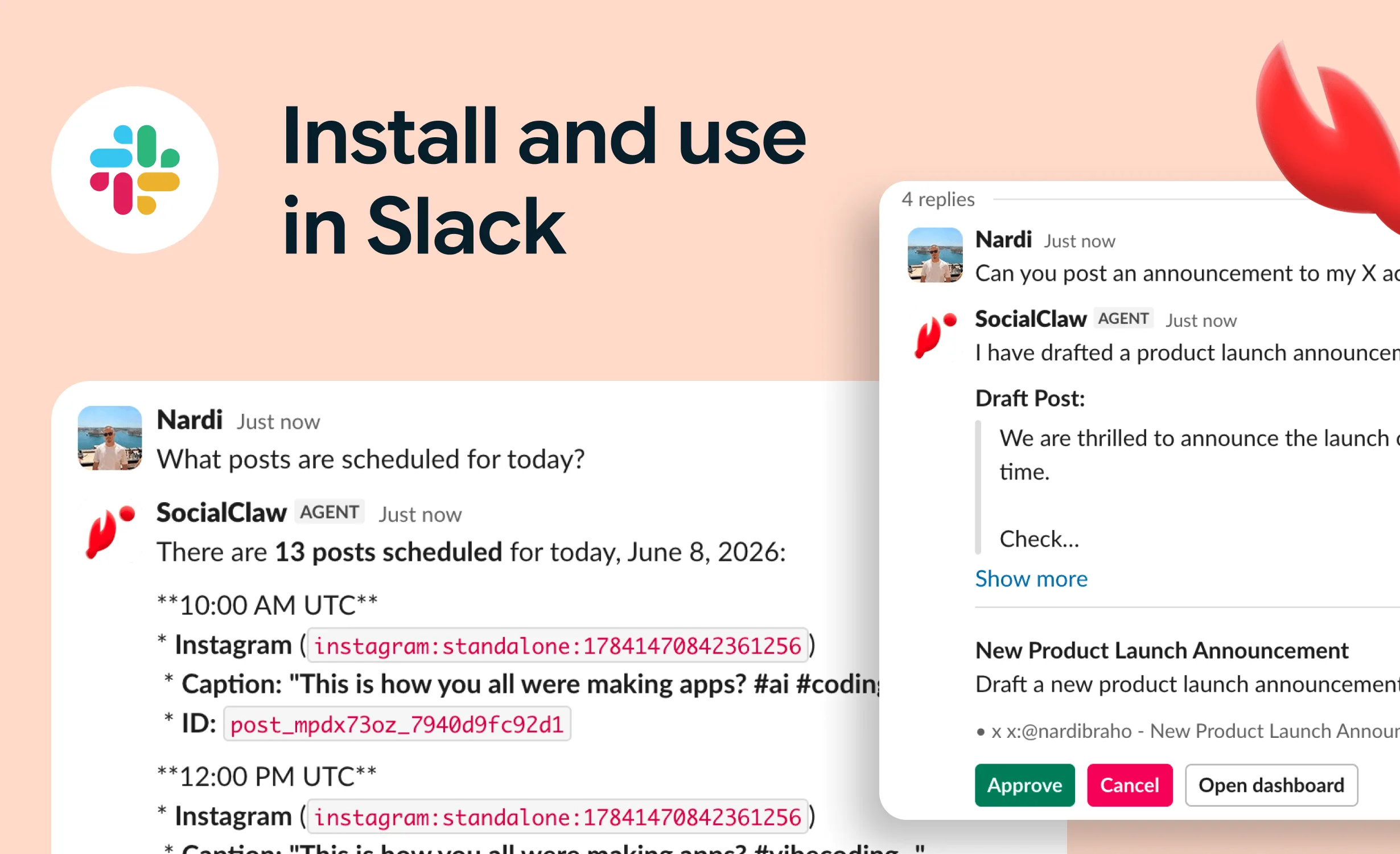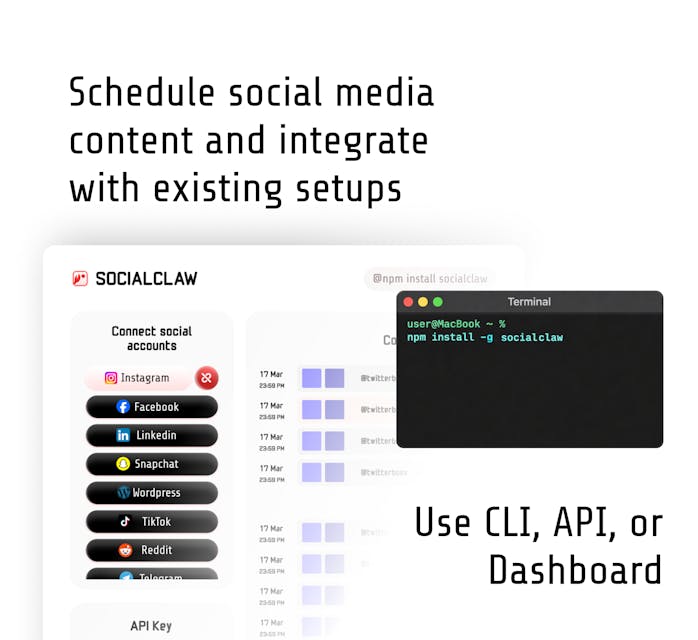
























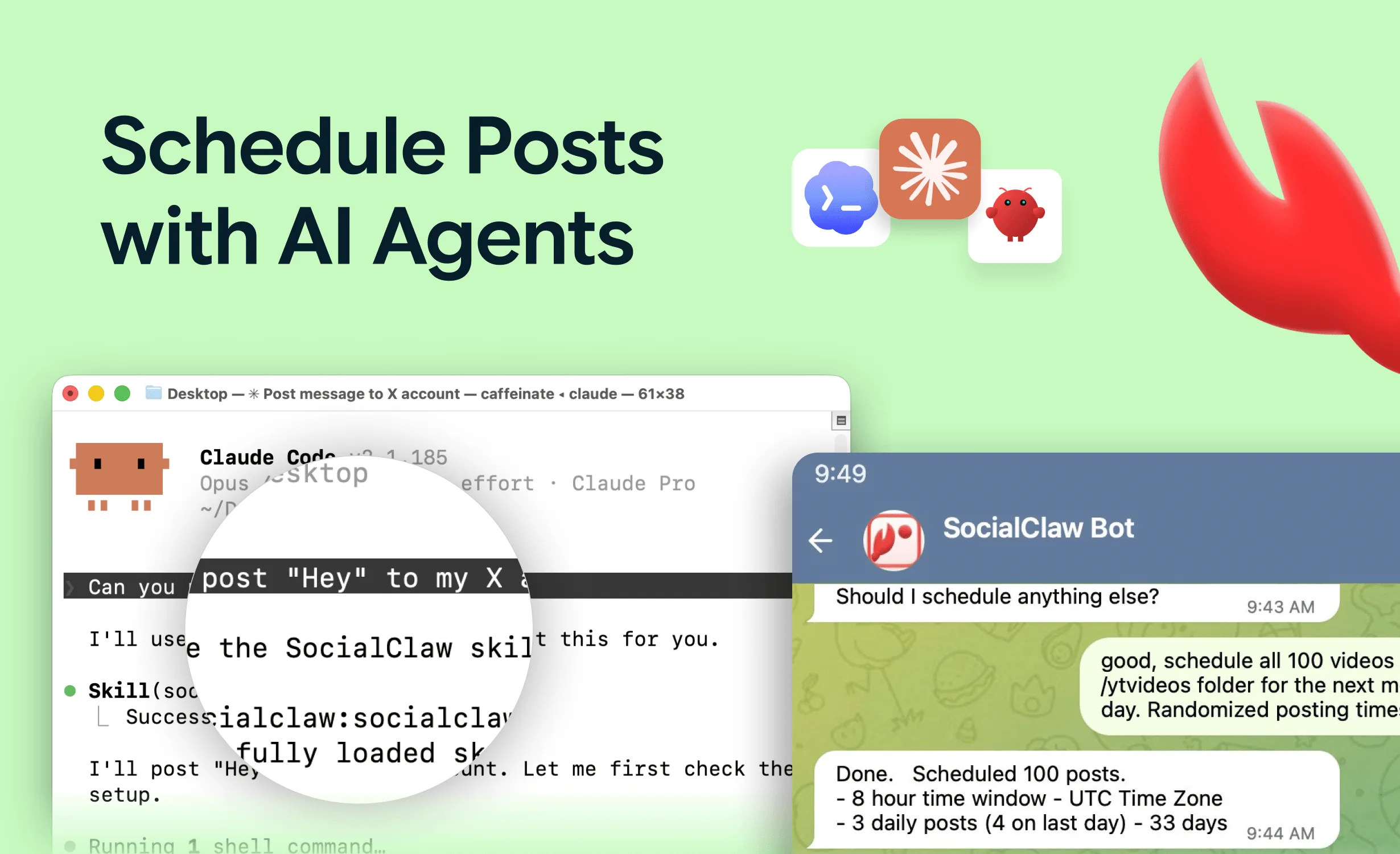
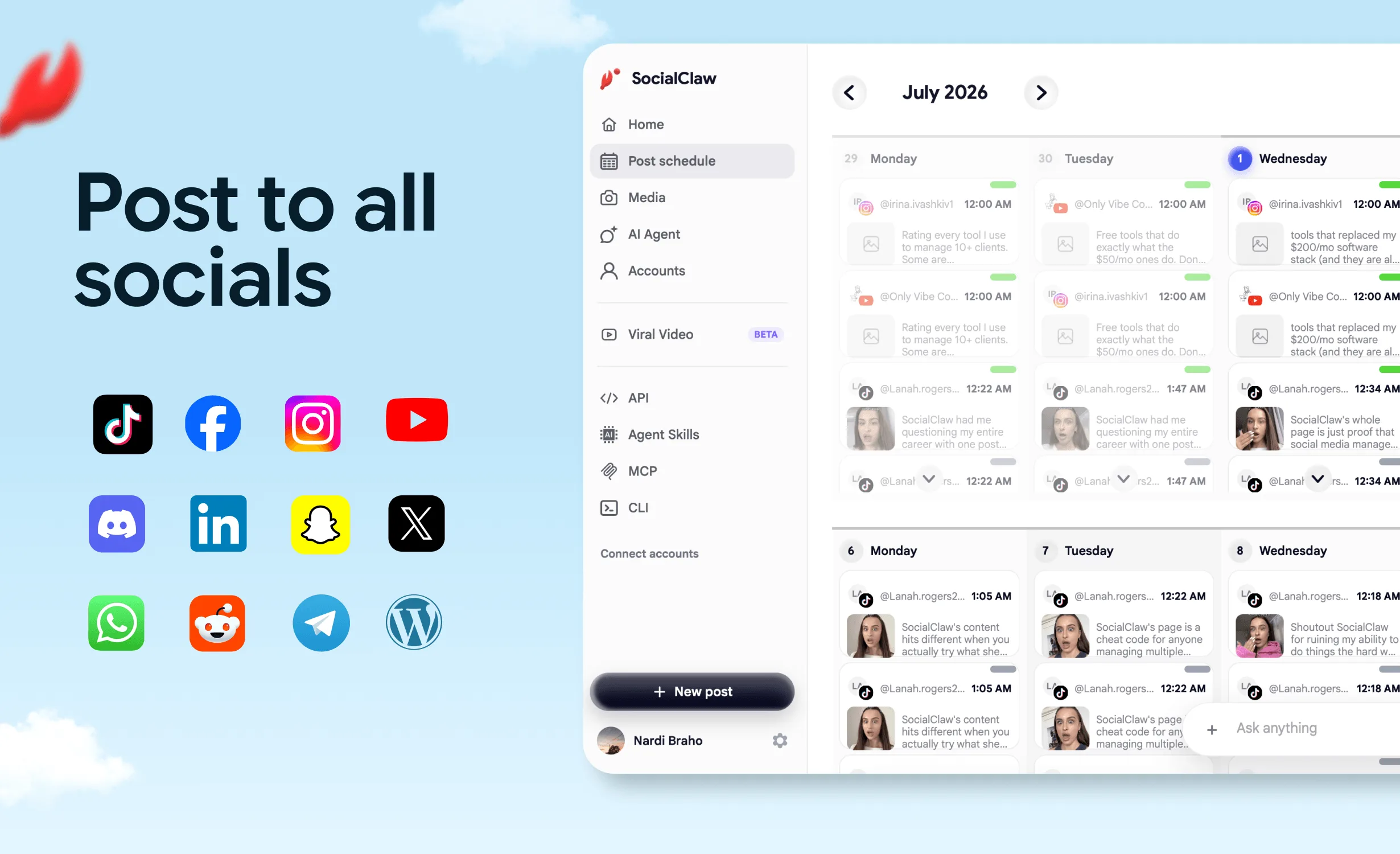
Social media tools have had "AI features" for years: caption rewriters, hashtag suggesters, best-time-to-post predictors. None of that changed who does the work. A human still opens the dashboard, clicks through the composer, and hits schedule.
Agentic social media management is the shift where that stops being true. The human sets direction — voice, cadence, campaign goals, approval rules — and an AI agent executes: it drafts the content, prepares the media, validates the payloads, schedules across platforms, and verifies delivery.
This article pins down the definition, the loop that makes it safe, the spectrum of human involvement, and what actually changes for teams that adopt it.
Nardi Braho - July 4, 2026
TL;DR
Agentic social media management = human-directed, agent-executed. The human owns strategy and standards; the agent owns execution through a validate → publish → verify loop over real publishing infrastructure (APIs or an MCP server), with human-in-the-loop checkpoints wherever the risk warrants them. It is not a caption generator bolted onto a scheduler.
How is agentic management different from AI-assisted scheduling?
The cleanest way to see the difference is to ask who performs each step of the publishing workflow.
| Workflow step | Traditional scheduler | AI-assisted scheduler | Agentic management |
|---|---|---|---|
| Strategy and voice | Human | Human | Human |
| Drafting content | Human | AI suggests, human edits | Agent drafts from a brief |
| Adapting per platform | Human | Human | Agent (per-platform payloads) |
| Preparing media | Human uploads each time | Human uploads each time | Agent uses hosted media, uploaded once |
| Checking constraints | Human remembers rules | Human remembers rules | Agent validates before apply |
| Scheduling | Human clicks | Human clicks | Agent applies the schedule |
| Verifying delivery | Nobody, usually | Nobody, usually | Agent inspects run and post state |
| Approvals | N/A | N/A | Human, at chosen checkpoints |
The load-bearing rows are the last three. An AI that writes captions but cannot validate, publish, or verify is an assistant. An agent that does all three — through real infrastructure, not a browser — is management.
What is the validate, publish, verify loop?
Agentic management only works when execution is structured. The canonical loop, using SocialClaw's tool names as the concrete example:
- Discover —
list_accounts, thenaccount_capabilities: what can each connected account actually accept? Instagram requires media and a professional account (a Meta rule, not a tool limit); Discord and Telegram are simpler targets. The agent asks instead of assuming. - Prepare —
upload_asset: media is uploaded once to hosted storage and referenced by URL across every post. - Validate —
validate_schedule: the full payload is checked against per-platform constraints before anything publishes. A text-only Instagram post or a PNG TikTok photo post fails here, cheaply, instead of publicly. - Publish —
apply_schedule: only validated payloads go out. - Verify —
run_statusandpost_attempts: platform "accepted" is not published. The agent inspects run and post state after publish and retries or escalates on failure.
That loop is the difference between automation you can trust and automation you babysit. The deep dive on step 3 is how to validate social posts before an AI agent publishes them.
Where do humans fit? The HITL spectrum
Human-in-the-loop is not a yes/no setting. Teams place checkpoints along a spectrum, usually per platform and per content type:
- Level 0 — drafts only. The agent prepares everything; a human triggers every publish. Good for week one, and for high-stakes channels.
- Level 1 — approve batches. The agent proposes a week of content; the human approves or edits the batch; the agent schedules and verifies. This is where most teams settle.
- Level 2 — approve by exception. Routine content (changelog posts, community updates) publishes automatically; anything novel or off-template routes to a human.
- Level 3 — full autonomy on scoped channels. Low-risk channels like a Discord announcements channel or a Telegram feed run unattended; the human reviews delivery reports.
Sane teams run different levels on different platforms simultaneously — Level 3 on Telegram, Level 1 on LinkedIn. How to pick that ladder, and why order matters, is covered in is it safe to let an AI agent run your social media.
What infrastructure does agentic management require?
Agents cannot click dashboards. Agentic management needs machine-facing publishing infrastructure with a few non-negotiable properties:
- A tool interface an agent can call. In 2026 that increasingly means MCP: SocialClaw exposes 17 tools over a hosted endpoint (
https://getsocialclaw.com/mcp) that Claude Code, Claude Desktop, and Cursor can call directly. The MCP server roundup compares the options. - Connected accounts that outlive the session. Accounts are connected once as connected customer accounts in a workspace; every agent run reuses them. No credentials in prompts — the workspace API key lives in MCP config or environment variables.
- Official platform APIs only. Browser automation gets accounts banned and cannot be validated. This is a hard requirement, not a preference.
- Validation and delivery state as first-class API surface. Without
validate_scheduleandrun_statusequivalents, the loop above is impossible and you are back to hoping.
What actually changes for teams?
The work shifts from execution to standards. Instead of writing every post, the social lead writes the brief, the voice guide, and the approval rules. Output volume stops being bounded by human clicking speed.
Review becomes batch-shaped. Approving Tuesday-to-Sunday in one sitting replaces composing daily. Teams report the surprising part is not time saved drafting — it is time saved on the mechanical scheduling and re-uploading.
Failure handling becomes explicit. Traditional workflows fail silently (a post never went out; nobody noticed for a week). Agentic workflows verify delivery as a step, so failures surface immediately with a reason attached.
New skills matter. Prompt and brief writing, reading validation errors, and setting per-channel autonomy levels become part of the social role. The broader playbook is in how to automate social media with AI agents.
Glossary: the terms that keep coming up
- Agent — an AI system that plans and executes multi-step work via tools, not just text generation.
- MCP (Model Context Protocol) — the open protocol agents use to call external tools; a social media MCP server exposes publishing as tools.
- Connected customer accounts — social accounts linked once to a workspace and reused across agent runs, API calls, and the dashboard.
- Workspace API key — the single credential (e.g.
sc_live_...) an agent uses; kept in config/env, never in prompts. - Validate before apply — checking full payloads against platform constraints before publishing anything.
- Hosted media — upload an asset once, reference it by URL everywhere.
- Run / post state — the inspectable record of what a publish actually did, per platform, after the fact.
- HITL (human-in-the-loop) — deliberate human checkpoints inside an otherwise automated flow.
FAQs
What is agentic social media management in one sentence?
It is social media operations where humans set direction and standards while AI agents execute the full publishing workflow — drafting, validating, scheduling, and verifying delivery — through real APIs with human checkpoints where risk requires them.
Is agentic social media management the same as AI scheduling?
No. AI scheduling tools help a human schedule faster (caption suggestions, timing predictions). Agentic management moves execution itself to the agent, including the steps schedulers leave to humans: per-platform adaptation, constraint validation, and delivery verification.
Do I still need a social media manager?
Yes — the role changes rather than disappears. Strategy, brand voice, community judgment, and knowing when not to post stay human. The mechanical execution layer is what the agent absorbs.
What tools do I need to start?
An agent runtime (Claude Code, Claude Desktop, or Cursor), a publishing layer with an MCP server or API (SocialClaw's free tier works: connect accounts at getsocialclaw.com/dashboard, add the MCP server with your workspace API key), and a written brief for voice and cadence.
Is it safe to let an agent publish without review?
On scoped, low-risk channels with validation and delivery verification in place — yes, and teams do. On high-visibility channels, keep batch approval. The full risk framework is in is it safe to let an AI agent run your social media.