























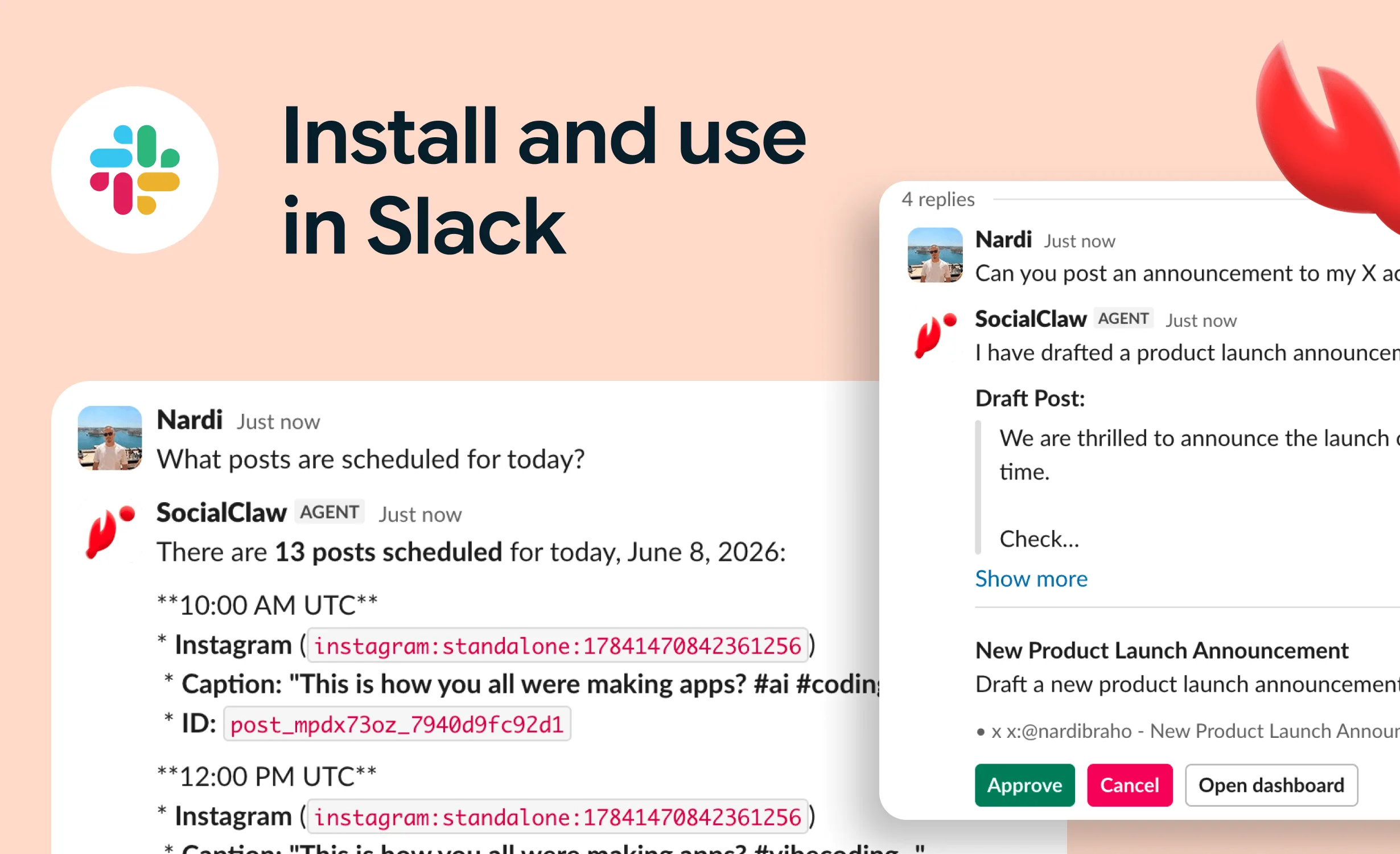
"What if it posts something insane at 3am?" is the question every team asks before letting an AI agent near their social accounts. It is the right question. Brand accounts are one bad post away from a screenshot that outlives the apology.
But the question is usually aimed at the wrong layer. Whether agent-run social media is safe has less to do with how smart the model is and almost everything to do with how the publishing pipeline is built: what the agent is allowed to do, what gets checked before publish, and what gets verified after.
The honest answer: unguarded, no — do not give a model raw account credentials and hope. Structured, with the guardrails below — yes, and the failure modes become both rarer and more visible than in most human-run workflows.
Nardi Braho - July 4, 2026
TL;DR
Safe agent-run social media = five guardrails + a rollout ladder:
1. Validate every payload before publish (never post blind).
2. Human-in-the-loop set per platform, not globally.
3. API keys in MCP config or env — never in prompts.
4. Official platform APIs only — browser automation is how accounts get banned.
5. Verify delivery after publish; "accepted" is not "published".
Roll out low-stakes first: Discord/Telegram → X/Reddit/Pinterest → Instagram/TikTok/YouTube → LinkedIn last.
What can actually go wrong?
Name the failure modes precisely and each one turns out to have a specific fix:
| Failure mode | Example | Guardrail that prevents it |
|---|---|---|
| Off-brand or embarrassing content | Wrong tone on a sensitive day, hallucinated product claims | HITL approval on high-stakes channels; written voice brief |
| Malformed posts | Text-only Instagram post, PNG photo post to TikTok, oversized video | Validate before apply (validate_schedule) |
| Silent delivery failure | Platform "accepted" the post, then dropped it in processing | Post-publish verification (run_status, post_attempts) |
| Credential leakage | API key pasted into a prompt, logged, or echoed in output | Keys live in MCP config/env only |
| Account bans | Automation via headless browser against the platform UI | Official platform APIs only |
| Runaway volume | Agent loops and schedules 400 posts | Batch approval; inspectable schedules before apply |
| Wrong account | Agent posts client A's content to client B | Explicit account discovery (list_accounts) and scoped workspaces |
Notice what is not on the list: "the model becomes malicious." Real incidents are boring — format errors, silent failures, leaked keys, terms-of-service violations. All of them are infrastructure problems with infrastructure answers.
What guardrails make an AI social media agent safe?
Validation before anything publishes
The single highest-leverage guardrail is refusing to publish unvalidated payloads. In SocialClaw's flow, the agent runs account_capabilities to learn what each connected account accepts, then validate_schedule to check the full payload against per-platform constraints — media requirements, format rules, length limits — before apply_schedule ever runs. A mistake caught at validation costs nothing; the same mistake caught by your audience costs trust. The full pattern is in how to validate social posts before an AI agent publishes them.
Human-in-the-loop, tuned per platform
All-or-nothing autonomy is the mistake. Set approval requirements per channel: a Telegram broadcast channel can run fully autonomous while LinkedIn requires sign-off on every post. The agent drafts everything either way; the difference is whether a human approves before apply_schedule. Practical setups for this are in how to build a human-in-the-loop AI social media workflow.
Credentials out of the conversation
The agent should authenticate through a workspace API key stored in MCP server config or environment variables — never typed into a prompt, never in the conversation transcript. Connected customer accounts live in the workspace; the agent gets capabilities ("publish to these accounts"), not passwords. If a transcript leaks, no credential leaks with it.
Official platform APIs only
Any tool that "automates" social media by driving a browser against the platform's web UI is a ban generator — it violates most platforms' terms, breaks on every UI change, and can't validate anything. Publishing through official platform APIs (as SocialClaw does exclusively) keeps the account in good standing and every action inspectable.
Delivery verification as a mandatory step
Platform "accepted" is not published. TikTok is the canonical example: a post can pass the API call and then fail platform-side checks minutes later (PNG photo uploads fail with file_format_check_failed — JPEG/WebP only, which SocialClaw auto-converts via ?format=jpeg). The agent's job is not done at publish; it inspects run and post state afterward and retries or escalates failures. Silent failure is a human-workflow disease; agents can actually be better at this than people.
What is a sane rollout ladder?
Do not start on the channel where a mistake hurts most. Grant autonomy in stages, and promote the agent only after a clean streak at the current stage:
- Stage 1 — Discord and Telegram. Your own community channels: mistakes are visible to friendly audiences, deletable, and low-consequence. Run the agent fully autonomous here first and watch the delivery reports.
- Stage 2 — X, Reddit, Pinterest. Public but fast-moving; individual posts are lower-stakes and correctable. Batch approval to start, then approve-by-exception. (Reddit adds subreddit-rule judgment — keep a human eye on targeting.)
- Stage 3 — Instagram, TikTok, YouTube. Media-heavy platforms with stricter formats and higher production stakes. Instagram requires a professional (business/creator) account — a Meta rule, not a tool limitation. Validation earns its keep here; keep batch approval.
- Stage 4 — LinkedIn, last. Professional identity, employer-visible, screenshot-prone, and the platform where tone errors cost the most. Many teams permanently keep per-post approval here, and that is a fine end state.
Two to four weeks per stage is typical. The point is not speed; it is building an evidence base — validation pass rates, delivery success, zero tone incidents — before raising autonomy. What "autonomy levels" mean concretely is defined in what is agentic social media management.
How do you know it's working? Measure the boring things
Safety is observable. Track: validation failure rate (should fall as prompts improve), delivery success rate after retries, human edit rate on drafts (falling edit rate = the brief is working), and time-to-detection for failures (should be minutes, not days). An agent pipeline with these numbers is more auditable than a human pasting into browser tabs — every post has a validation record and a delivery trail.
FAQs
Is it safe to let an AI agent post to social media without review?
On low-stakes, scoped channels (Discord announcements, a Telegram feed) with validation and delivery verification in place — yes. On high-visibility channels like LinkedIn, keep human approval. Safety is a per-platform setting, not a yes/no decision.
Can an AI agent get my social media account banned?
The realistic ban risk comes from tooling, not content: browser automation and unofficial APIs violate platform terms. Publishing through official platform APIs with proper OAuth — the only way SocialClaw operates — is the same mechanism every scheduler uses and is explicitly supported by the platforms.
What stops an agent from posting something off-brand?
Layers: a written voice brief the agent drafts from, validation for structural errors, and human approval on the channels where tone matters most. No single layer is perfect; the stack is what makes incidents rare — and drafts are reviewable before publish, unlike a rushed human post.
Should the AI agent have my account passwords?
No, and it never needs them. Accounts are connected once via OAuth into a workspace; the agent authenticates with a workspace API key stored in MCP config or environment variables. The agent can publish to connected accounts but never sees or handles the credentials themselves.
Which platform should an AI agent post to first?
Discord or Telegram. Friendly audience, deletable mistakes, simple formats. Save LinkedIn for last — it is where errors are most expensive. Follow the four-stage ladder above and promote on evidence.
What tools support this kind of guarded setup?
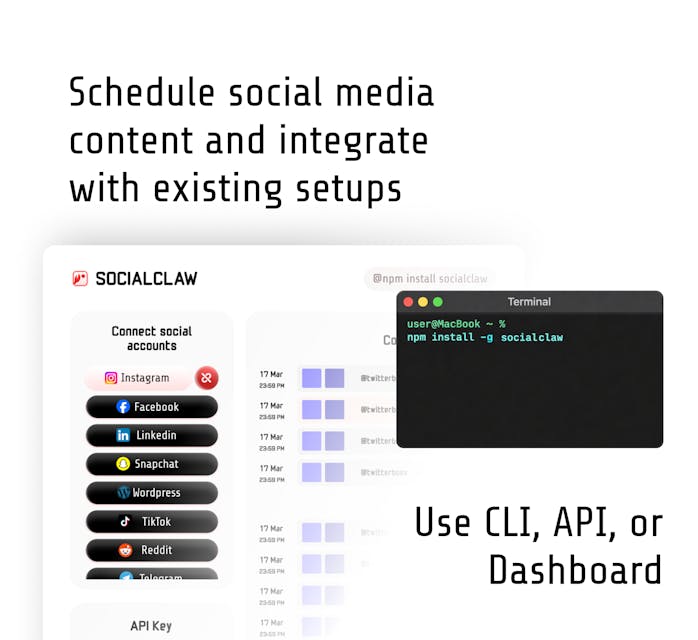
Any stack with validation, per-platform HITL, and delivery inspection. SocialClaw exposes exactly this loop as 17 MCP tools (hosted at https://getsocialclaw.com/mcp) plus a CLI and API — see the best social media MCP servers roundup for the wider landscape.