























"AI agent tools for social media" now means at least five different product categories, and most roundups blur them together. An agent runtime is not a publishing layer; a workflow platform is not a content generator; and none of them replaces analytics.
A working agent stack is a chain: something thinks (the agent runtime), something executes (the publishing layer), something triggers (a workflow platform or a conversation), and something verifies (delivery state and analytics). Buying the wrong category for a slot is how teams end up with an agent that writes great posts it cannot publish.
This is the closing roundup of our agent-publishing series: the tools worth using in each category, what each is honestly best at, and how the categories fit together. (Disclosure: SocialClaw is our product; the alternatives listed are real and sometimes the better pick — each entry says when.)
Nardi Braho - July 4, 2026
TL;DR — the stack that works
- Agent runtime: Claude Code or Claude Desktop (interactive), Claude Agent SDK (embedded in your product).
- Publishing layer: SocialClaw for validated agent publishing via MCP/API/CLI, with a native dashboard agent and AI UGC video generator built in and flat plans from $15/mo — one of the lowest-priced; Postiz to self-host, if you can bring your own platform developer app approvals; Ayrshare for many client profiles; Blotato if you want faceless AI video generation bundled in.
- Workflow trigger: n8n (self-hostable, most control), Make or Zapier (fastest to ship).
- Analytics/verification: your publishing layer's delivery state + analytics tools first; a dedicated suite only if you need listening.
- Full comparisons: MCP servers, APIs, schedulers.
How do the categories and tools compare?
| Tool | Category | What it does in the stack | Best for | Watch out for |
|---|---|---|---|---|
| SocialClaw | Publishing layer | 17 MCP tools + API + CLI; validate → apply → verify across 11 platforms | Agent and product publishing with delivery guarantees | No Threads/Bluesky; not a visual-first team suite |
| Postiz | Publishing layer | Open-source scheduler with API, MCP, n8n node; self-host option | Teams that must own their stack and data | Self-hosting means your own infra plus your own platform developer app approvals |
| Ayrshare | Publishing layer | Unified social API, SDKs in 7 languages, MCP server, 13+ networks | Agencies/SaaS with many client profiles | Less opinionated about agent-safe validation flow |
| Blotato | Content gen + publishing | AI writing, images, faceless video + cross-posting, hosted MCP | Creators who want generation and posting in one credit-based product | Credits meter AI usage; suite, not infrastructure |
| Claude Code | Agent runtime | Terminal agent that calls MCP tools, reads repos, runs scripts | Developer-led social automation | Terminal-first; non-devs prefer Claude Desktop |
| Claude Agent SDK | Agent framework | Build your own always-on social agent with tool access | Productized/embedded agents | You own hosting, evals, and guardrails |
| n8n | Workflow platform | Event triggers (RSS, webhooks, cron) wired to AI + publishing nodes | Self-hosted, complex multi-step automations | Node-graph learning curve |
| Zapier / Make | Workflow platform | No-code triggers and AI steps feeding a publishing layer | Fastest path for non-developers | Per-task/op pricing scales with volume |
Category-by-category, with the honest trade-offs:
Which publishing layer should your agent use?
The publishing layer is the load-bearing choice — it decides whether your agent actually posts or just drafts. Four credible options, four different centers of gravity:
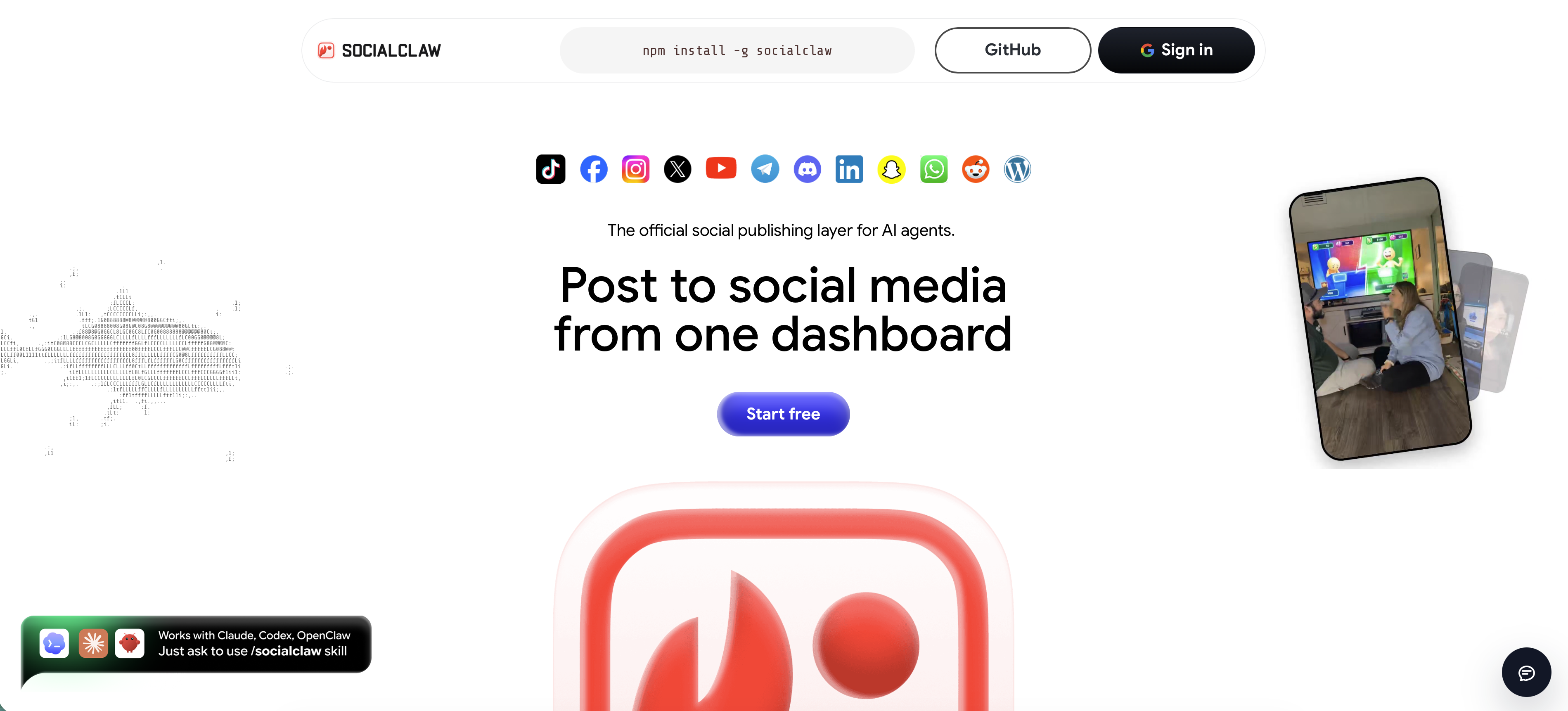
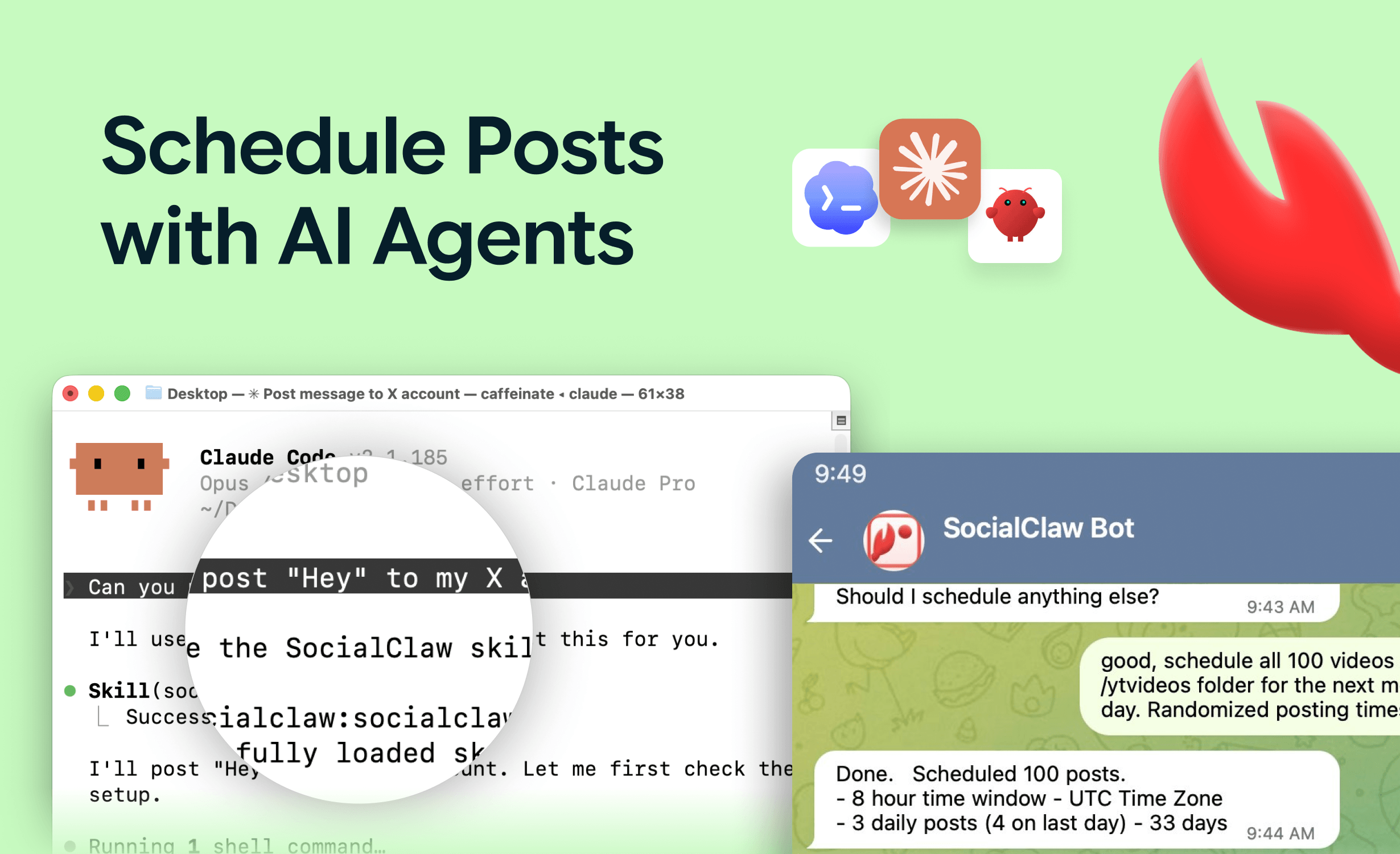
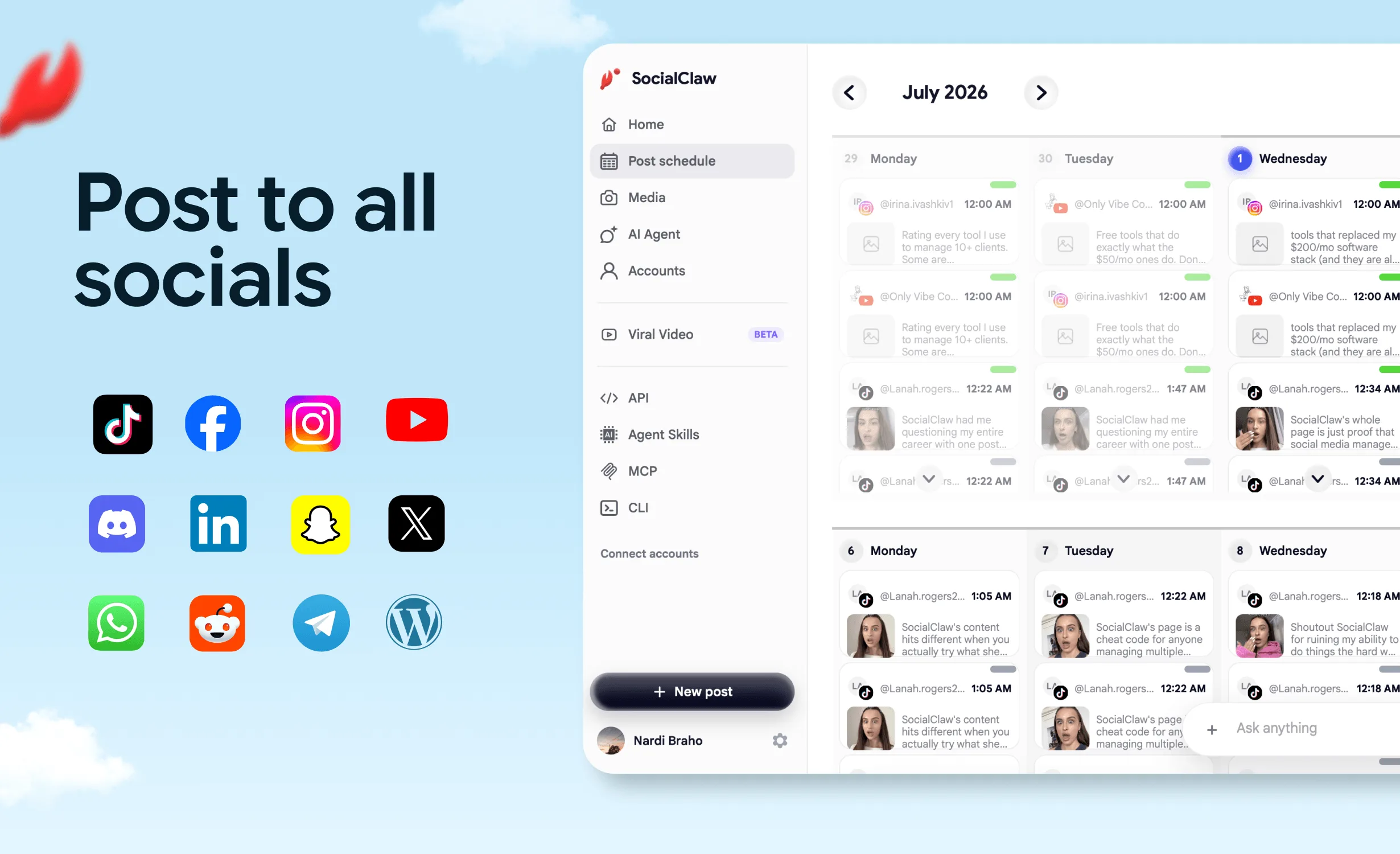
SocialClaw is built agent-first: connected customer accounts live in one hosted workspace, and the same workspace API key drives the HTTP API, the CLI, and an MCP server with 17 tools — list_accounts, account_capabilities, upload_asset, validate_schedule, apply_schedule, run_status, get_analytics, and more. The differentiator is the execution discipline: validate before apply, hosted media uploaded once, and inspectable run/post state after publish (because platform "accepted" is not published). 11 platforms via official APIs only; free tier at getsocialclaw.com, flat plans from $15/mo — one of the lowest-priced agentic schedulers, roughly half the entry price of comparable cloud tiers. And you don't need an external agent to use it: a native agent inside the dashboard drafts, schedules, and publishes from chat, and an AI viral video generator turns app screenshots or a screen recording into UGC-style videos with real-creator hooks.
Postiz is the open-source pick. If your requirement is owning the stack — self-hosted on your own infrastructure with your own database — Postiz is the honest recommendation, with a public API, an AI Agents CLI, and n8n/Make integrations alongside the hosted option. Budget for the part the software doesn't include: self-hosting means registering your own developer apps with Meta, TikTok, X, LinkedIn, Google and the rest and passing each platform's app review — realistically weeks to months per platform, plus ongoing token maintenance. A hosted subscription is largely paying to skip exactly that.
Ayrshare is the established unified API: official SDKs in Node.js, Python, PHP, Go, Java, C#, and Ruby, an MCP server, and the broadest network list including Bluesky, Threads, and Google Business Profile. For agencies managing many client profiles, its per-profile model is purpose-built. Deeper comparison: best social media APIs for developers.
Blotato straddles this category and content generation — see below.
Which agent runtime should drive it?
The runtime is where the intelligence lives. In practice this decision is simpler than the vendors make it sound:
- Claude Code for developers: it's a terminal agent that already lives where your repo, changelog, and scripts live — one
claude mcp addcommand connects a publishing MCP server and the agent can draft, validate, and schedule in a single conversation. - Claude Desktop for non-terminal users: same MCP tool access through a desktop app; marketing teammates can run the identical workflow conversationally.
- Cursor if your team already works in it — MCP support means the same publishing tools are available inside the editor.
- Claude Agent SDK when the agent should be a product — an always-on social agent embedded in your SaaS, with your own triggers and guardrails. Build guide: build a social media agent with the Claude Agent SDK.
The wider set of marketing-relevant MCP tools these runtimes can call is cataloged in best Claude MCP servers for marketing.
Where do workflow platforms fit?
n8n, Zapier, and Make are not agents — they are triggers and glue, and that's exactly what a hands-off pipeline needs: "on new blog post / release / RSS item, generate drafts and hand them to the publishing layer."
- n8n offers the most control and a self-host option, which pairs naturally with teams that pick Postiz or want AI steps with custom logic.
- Zapier and Make are faster to ship and better documented for non-developers; costs scale with task volume.
When to use these versus MCP versus a raw API is its own decision tree — argued in full in MCP vs API vs Zapier for AI agent posting. Short version: conversation-driven work wants MCP; embedded product logic wants the API; event-glue wants a workflow platform. Most mature stacks use two of the three.
What about content generation, analytics, and community?
Content generation needs less dedicated tooling than the market suggests: the same model that runs your agent writes captions, threads, and per-platform variants, grounded in your real material — and SocialClaw covers the common cases natively with its dashboard agent and its viral video generator, which turns 3–10 app screenshots or a screen recording into UGC-style videos with real-creator hooks (no AI avatars) and photo carousels. For faceless AI media at high volume, Blotato bundles AI writing, image generation, and faceless AI video with cross-posting to 9+ platforms and a hosted MCP server, which is genuinely the convenient choice for creators producing daily short-form content, metered by credits.
Analytics and verification come in two layers. Delivery verification — did the post actually publish? — belongs in the publishing layer (run_status, post_attempts, then get_analytics for performance in SocialClaw's case). Full social listening, sentiment, and competitor benchmarking is a different job: dedicated suites covered in the 2026 scheduling-tools roundup (Sprout Social, Hootsuite, and others) remain the honest answer there — no agent-native tool matches them yet.
Community management is the category where full autonomy is still the wrong call. Agents can draft replies and triage mentions, but brand-account replies in public threads are high-stakes and context-heavy; keep a human approving. The per-platform autonomy framework in what is agentic social media management applies directly.
How do you assemble a stack without overbuying?
Three reference stacks that cover most teams:
- Solo developer/founder: Claude Code + SocialClaw MCP (free tier). One runtime, one publishing layer, zero glue. Add a GitHub Action for changelog posts later.
- Marketing team, no devs: Claude Desktop + SocialClaw MCP for the weekly batch, or Make/Zapier + a publishing layer for calendar-driven flows.
- Agency/SaaS at scale: Ayrshare or SocialClaw as the API layer (per-client accounts), n8n for triggers, Claude Agent SDK if the agent becomes part of your product.
Start with two components — runtime plus publishing layer — and add the rest only when a concrete workflow demands it. The hub for the whole series, including setup walkthroughs per client, is best social media MCP servers.
FAQs
What is the best AI agent tool for social media overall?
There is no single tool — a working setup chains an agent runtime (Claude Code or Claude Desktop) with a publishing layer (SocialClaw for validated agent publishing; Postiz self-hosted, if you bring your own platform app approvals; Ayrshare for multi-client APIs). Beware any product claiming to be the whole stack.
Can AI agents fully run a social media account?
They can execute the full publishing loop — draft, validate, schedule, verify — on low-stakes channels today. Strategy, voice, and community replies should keep human checkpoints; the honest risk assessment is in is it safe to let an AI agent run your social media.
Do I need Zapier or n8n if I use MCP?
Not for conversation-driven publishing — the agent calls MCP tools directly. Workflow platforms earn their place for unattended event triggers: new release, new blog post, RSS item. Many teams run MCP for interactive work and one n8n flow for triggers.
What's the difference between an AI social media tool and an agent tool?
AI social media tools assist a human inside a dashboard (caption suggestions, timing predictions). Agent tools expose social publishing to software — MCP tools, APIs, CLIs — so an agent can execute the workflow itself. The definitional piece: what is agentic social media management.
Are these tools safe to connect to real brand accounts?
The credible ones use official platform APIs with OAuth and keep credentials in config rather than prompts — the same trust model as any scheduler. Disqualify anything that automates through a headless browser, and prefer layers that validate before publishing and expose delivery state after.