























There are three fundamentally different ways to let software post to your social accounts: give an AI assistant tools (MCP), write code against a REST API, or wire up a no-code workflow platform like Zapier. They overlap enough to be confusing and differ enough that picking the wrong one costs you weeks.
The confusion comes from all three ending in the same place — a post going live — while starting from completely different questions. MCP starts with "an AI decides what to do." An API starts with "my code decides what to do." Zapier starts with "an event happened, run the recipe."
This guide is the decision framework: what each path actually is, an honest comparison table, and who should pick which. (Disclosure: SocialClaw supports all three paths, so we don't have a horse in this race beyond you picking correctly.)
Nardi Braho - July 4, 2026
Which to pick, in one minute:
>
- You want to prompt an assistant in plain language ("draft and schedule a launch thread") → MCP. The AI decides which tools to call.
- You're building a product or pipeline in code → API. Deterministic, testable, yours.
- You want event → post with no code and no AI judgment ("new blog post → share everywhere") → Zapier/n8n/Make. Fastest for simple triggers.
- Mixed needs? They compose. A common stack: Zapier catches the trigger, an AI step drafts, the API publishes.
What do the three paths actually mean?
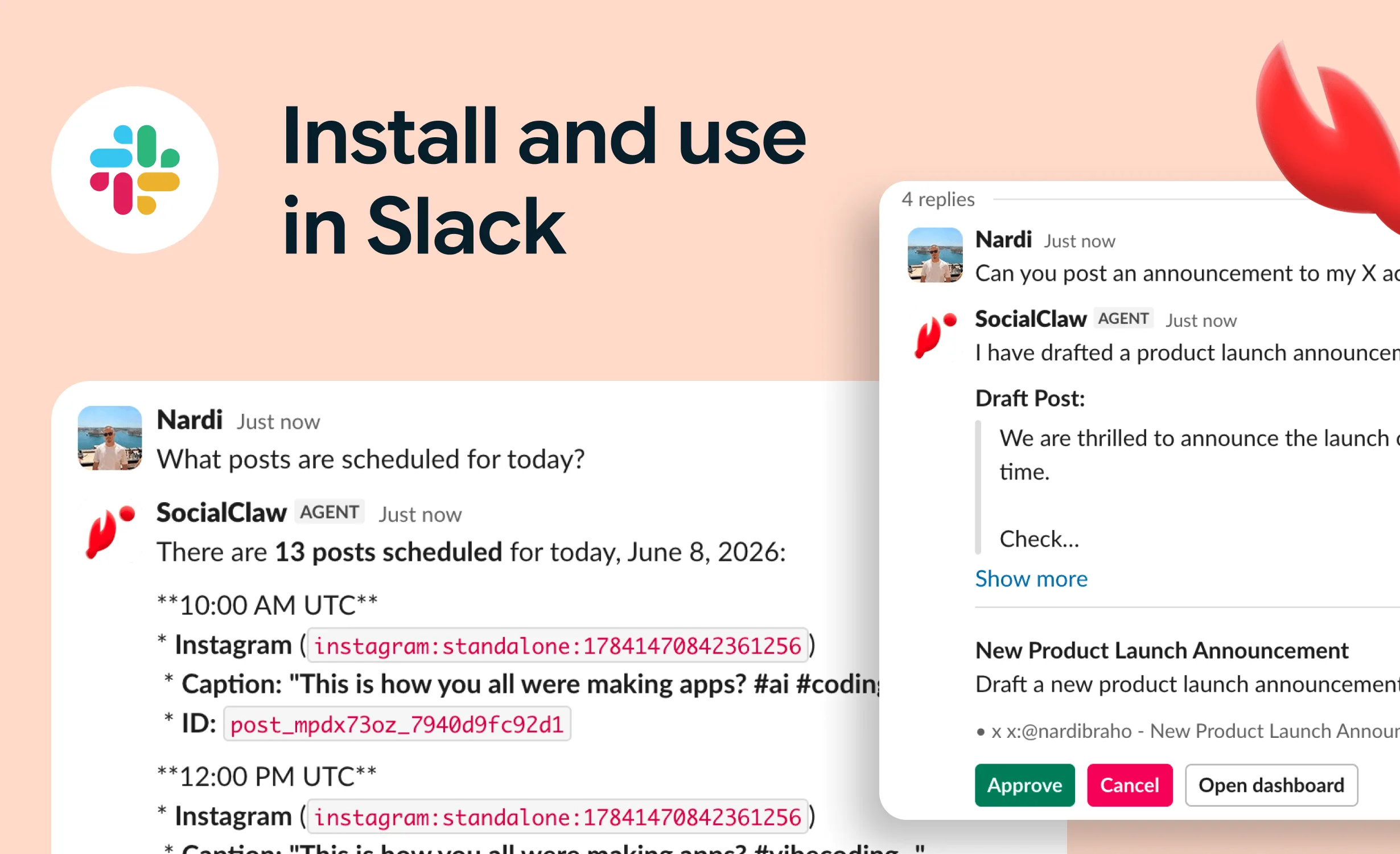
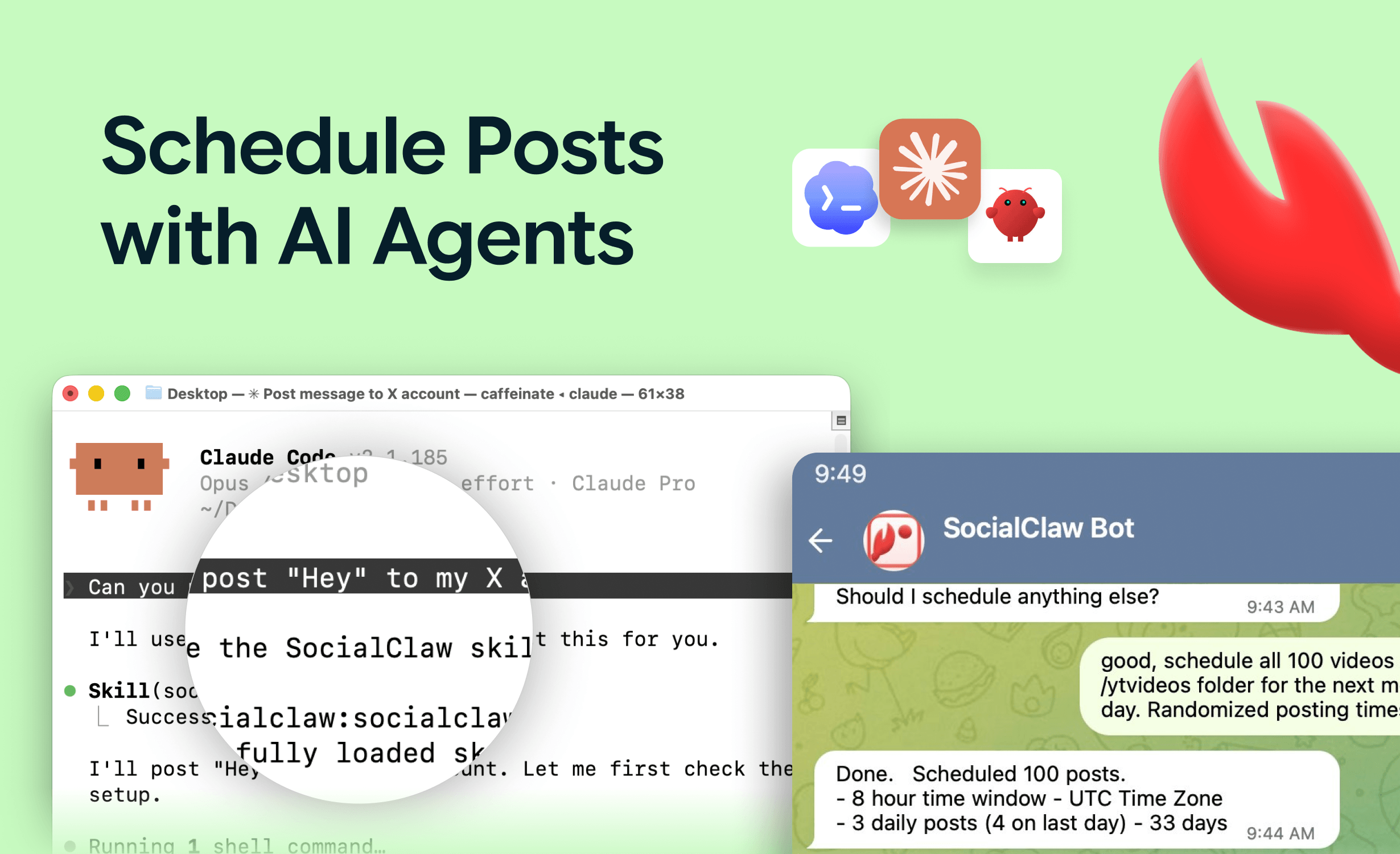
MCP (Model Context Protocol) is an open standard that exposes actions as tools an AI model can call. You add a social publishing MCP server to Claude, ChatGPT, Cursor, or a custom agent; the model reads your intent and chooses which tools to invoke — list accounts, upload media, validate, schedule, verify. The intelligence lives in the model. (Full definition here.)
A REST API is the classic path: your code makes HTTP calls to endpoints. No model in the loop unless you put one there. Everything is explicit — which is the point.
Zapier (and peers like n8n and Make) is event-driven workflow automation: a trigger (new RSS item, new GitHub release, new row in a sheet) fires a chain of steps. Modern versions include AI steps for text generation, but the flow is fixed — the recipe runs the same way every time.
MCP vs API vs Zapier: the comparison table
| MCP | API | Zapier | |
|---|---|---|---|
| Who decides what happens | The AI model, per request | Your code, deterministically | The recipe you built, per event |
| Setup time | Minutes (one config block) | Hours–days (code + auth + error handling) | Minutes–hour (visual editor) |
| Skill needed | None after setup — plain language | Programming | No-code; logic via visual steps |
| Flexibility | High — handles novel requests without new code | Total — anything the endpoints allow | Low–medium — bounded by available steps |
| Latency | Conversational (seconds; model reasoning) | Milliseconds per call | Trigger polling can add minutes |
| Determinism | Lower — the model chooses the path | Highest | High — same recipe every run |
| Failure visibility | Good if tools expose state (run status, attempts) | As good as you build it | Task history; depends on the app's error surface |
| Typical cost | LLM tokens + publishing service | Publishing service + your dev time | Zapier task-based pricing + publishing service |
| Best at | Judgment work: drafting, adapting, deciding | Products, pipelines, scale | Simple event → action glue |
When is MCP the right choice?
When the work requires judgment on every run. "Read this changelog and announce the most interesting change, in our voice, adapted per platform" is not a recipe — it's a decision. That's model territory.
MCP is also the only path where non-developers get real automation: after a one-time config, a marketer in Claude Desktop has the same publishing power a developer has in code. Setup is a single command or JSON block against a hosted endpoint like https://getsocialclaw.com/mcp (setup guide).
The honest caveat: MCP is the least deterministic path. The model might structure a post differently across runs. Good MCP servers compensate with guardrails — SocialClaw's tools enforce validate before apply and expose run status after publish, so the model's freedom is bounded by preflight checks and verifiable delivery.
Pick MCP if: you prompt in plain language, content varies per run, or an AI agent is already the center of your workflow.
When is the API the right choice?
When posting is a feature of something you're building — a SaaS that publishes on behalf of users, a content pipeline with its own logic, anything needing tests and CI. Code paths don't improvise; that's their value. (The distinction between a scheduler tool and a scheduler API is covered in scheduler API vs management tool.)
The API path costs the most upfront: authentication, media handling, retries, per-platform rules. A unified publishing API absorbs most of that — one integration instead of eleven platform integrations, with hosted media and validation endpoints so you don't rebuild preflight logic. SocialClaw's REST API (docs at /docs/api) shares the same workspace and connected accounts as its MCP server, which means you can prototype via MCP prompts and productionize the same flows in code without re-connecting anything.
Pick the API if: you're a developer, the workflow is stable, or the publishing lives inside your product.
When is Zapier the right choice?
When the job is glue. "New blog post → post the link to X and LinkedIn" doesn't need a model deciding anything or code you maintain — it needs a trigger and two actions, and Zapier does that in an afternoon.
Two honest limits. First, recipe-shaped automation gets brittle as logic grows — once you want per-platform adaptation, approval steps, and delivery verification, you're fighting the tool. Second, SocialClaw has no official Zapier app today — the working pattern is Zapier's Webhooks/HTTP step calling the SocialClaw API, which is genuinely simple but is configuration, not a branded one-click integration. The full walkthrough (including adding an AI drafting step) is in how to auto-post with Zapier + AI, and the same pattern applies to n8n and Make.
Pick Zapier if: the trigger is an event, the output is predictable, and nobody on the team wants to touch code or prompts.
Can you combine them?
Yes — and mature setups usually do, because the paths compose cleanly when they share one publishing backend:
- Zapier + AI + API: trigger on a new blog post → AI step drafts platform variants → webhook step publishes via the API.
- MCP to prototype, API to ship: design the flow conversationally with Claude, then port the exact tool sequence (validate → apply → verify) to code.
- MCP + cron: an agent built on the Claude Agent SDK runs the judgment work unattended on a schedule.
Since the accounts connect once at the workspace level, all three paths publish through the same OAuth connections — you're choosing an interface, not re-doing integrations.
FAQs
Is MCP replacing APIs?
No. MCP is a layer that exposes API-backed actions to AI models as tools — under every good MCP server sits an API. The question isn't which wins; it's whether a model or your code should decide what happens on each run.
Which option is cheapest?
For one simple recipe, Zapier. At volume or in a product, the API (no per-task fees, no token costs). MCP adds LLM token costs, which buy you drafting and judgment — worth it exactly when that judgment replaces your time. On the publishing-service side of the equation, SocialClaw's flat plans start at $15/mo with a free tier — one of the lowest-priced agentic schedulers, roughly half the entry price of comparable hosted tiers.
Which is safest for an AI agent?
MCP with a well-designed server. Counterintuitive but true: a server that enforces validation before publishing and exposes delivery state gives an agent tighter guardrails than raw API access, where nothing stops a buggy script from posting garbage eleven times.
Can ChatGPT use these too, or just Claude?
ChatGPT supports MCP connectors (with an auth caveat worth knowing) and the OpenAI API can point at MCP endpoints — details in connecting ChatGPT to your social accounts. The API and Zapier paths are model-agnostic by nature.
Does SocialClaw really support all three?
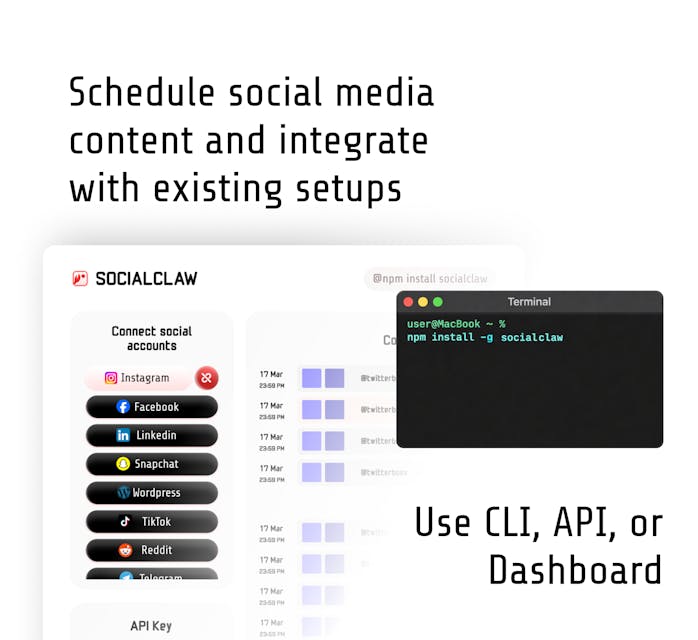
Yes: a hosted MCP endpoint (https://getsocialclaw.com/mcp), a REST API with a CLI (npm install -g socialclaw), and webhook-compatible HTTP endpoints that Zapier/n8n/Make call. One workspace, one set of connected accounts, three interfaces. Which MCP servers lead the category overall is ranked in the hub guide.